

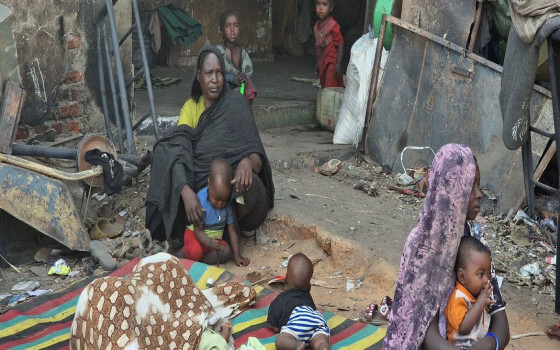
The world's most neglected crisis: UN warns of escalating violence in Sudan and new displacement in Kordofan and Darfur. The brutality of the conflict knows no bounds amid immense suffering for civilians.

- Europe and Arabs
- Tuesday , 23 December 2025 11:2 AM GMT
Khartoum – New York: Europe and the Arabs
The United Nations has expressed grave concern over the escalating violence against civilians in Sudan, which is "leading to new waves of displacement and human suffering, particularly in the Kordofan region."
According to the UN's daily news bulletin, UN Spokesperson Stéphane Dujarric stated during the daily press briefing in New York on Monday that displacement has increased sharply in recent days in South Kordofan State. The International Organization for Migration (IOM) estimates that on Friday alone, "the growing insecurity forced nearly 500 people to flee villages in the Eastern Rural area and seek refuge in Kadugli and surrounding areas, as well as in North Kordofan State." In addition, more than 15,000 people have been displaced from the region to White Nile State since late October, according to local authorities.
Meanwhile, local authorities in Gedaref reported the arrival of approximately 400 people from the towns of Babanusa and Heglig in West Kordofan State to the city yesterday. “While community kitchens have provided immediate food assistance, there is an urgent need for shelter assistance, especially as we anticipate the arrival of more people seeking safety,” said Mr. Dujarric.
The tragedy in Darfur continues.
Regarding the situation in Darfur, the International Organization for Migration (IOM) estimates that more than 107,000 people have been displaced from El Fasher and surrounding villages since the Rapid Support Forces (RSF) “violently” seized control of the city in late October. Mr. Dujarric said many of them have already been displaced multiple times after fleeing camps such as Zamzam and Abu Shouk.
More than 2,500 people also arrived in Sha’iriya locality in South Darfur last week and are in dire need of food and other basic relief items, as well as health services, according to the UN spokesperson.
At least 10 killed in Al Malha.
Mr. Dujarric noted the drone attack on a crowded market in Al Malha, North Darfur, which killed at least 10 people, according to first responders. He urged all parties to immediately cease attacks on civilians and civilian infrastructure, respect international humanitarian law, and ensure safe and unhindered humanitarian access, "so that next year does not witness the same suffering as before."
"The world's most neglected crisis"
In response to journalists' questions, Mr. Dujarric said that Secretary-General António Guterres is "deeply frustrated," not only by the lack of efforts to resolve the crisis in Sudan, but also by the "level of human suffering" in the country this year. He said that the leaders of the government and the Rapid Support Forces must put the interests of the Sudanese people first, "as must all regional and international powers."
Asked about major aid organizations describing the crisis as the world's most neglected, Mr. Dujarric said that the United Nations, its agencies, and its partners are keen to focus on Sudan and keep it in the media spotlight. He added: “I think if the Secretary-General were here, he might tell you that there is an element of racism. People and the global media don’t pay as much attention to crises in Africa as they do to other parts of the world. There are also many crises and much human suffering. But we have to be able to keep all these issues at the forefront of attention.”
A UN official said that every passing day brings shocking levels of violence and destruction in Sudan, where civilians are enduring “immense and unspeakable suffering, with no end in sight.” This came during a Security Council meeting to discuss the rapidly deteriorating situation in Sudan, where escalating fighting has caused immense harm to civilians and widespread displacement.
In his briefing to the Council on Monday evening, UN Assistant Secretary-General for the Middle East, Asia and the Pacific, Khaled Khiari, reported that the conflict has been concentrated in the Kordofan region in recent weeks, where the Rapid Support Forces have made “significant gains.” He addressed recent reports that members of the Sudanese Armed Forces had withdrawn from Babanusa and Heglig into South Sudan, and that South Sudanese forces had entered Sudan to protect oil infrastructure in Heglig.
He warned that these recent developments reflect "the increasingly complex nature of the conflict and its expanding regional dimensions. If these developments are not addressed, Sudan's neighbors could become embroiled in a regional conflict within and around Sudan."
Khiari also noted that a particularly worrying feature of the conflict is the increasing use of drones in indiscriminate attacks by both sides, resulting in large numbers of civilian casualties.
He pointed out that the continued flow of increasingly sophisticated and lethal weapons remains a major driver of the conflict, adding that "calls to stop these flows have been ignored, and no one has been held accountable."


No Comments Found