
The Netherlands awaits the announcement of the new government... Parliamentary blocs approve a coalition agreement that lacks a majority.

- Europe and Arabs
- Thursday , 29 January 2026 16:20 PM GMT
The Hague: Noureddine Amrani
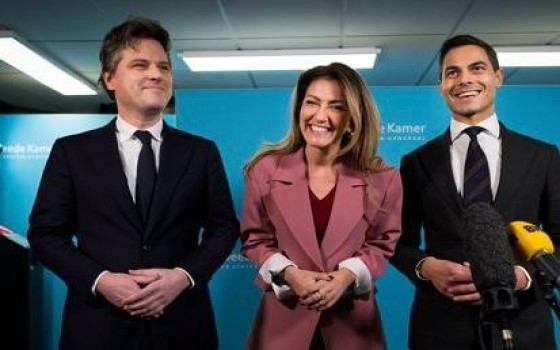
The formation of Rob Yeaten's government has entered its final stage after the coalition agreement received the approval of the three parliamentary groups participating in the government.
The coalition government will submit the document to the remaining members of the House of Representatives (the lower house) tomorrow, Friday.
Rob Yeaten can now be considered the next Prime Minister after his swearing-in ceremony in the House of Representatives next Wednesday.
The leaders of the parties, Yeaten, Wesselgosz, and Ponteball, reached an agreement on the broad outlines on Tuesday evening and confirmed on Wednesday that they had put the "final touches" on it. On Wednesday evening, their agreement was sent to the parliamentary groups, all of which approved it after hours of deliberation. Rob Yeaten (D66) told the assembled press that there were still "a few minor points" to agree on, but that his parliamentary group could otherwise approve them. He said: "Sometimes there are things you agree on as negotiators and you think: This is really great. But when someone reads it for the first time, and asks a few questions, you think: Maybe we should phrase this differently." These observations and comments were discussed again on Thursday morning by the three negotiating parties. Çetin does not expect any "very complicated issues" to be raised.
According to party leader Dilan Yesilgöz, the VVD parliamentary group is "very positive" about the agreement. She said, "Of course, there are also sentences in the text that members of the group are questioning: What exactly is meant by this? Has this been taken into account? I have also received a number of technical points."
"The fastest government formation"
After reaching an agreement with Pontineball Yesilgöz, Prime Minister-designate Çetin expressed his satisfaction that the formation process was nearing completion. He said, "This will be one of the fastest government formations in recent decades."
This is not entirely accurate: If Çetin's government stands as planned on the steps of the Royal Palace on February 23, it will have been 117 days since the election. The three previous prime ministers, Kok, Balkenende, and Rutte, formed governments more quickly in 1994, 1998, 2002, 2007, and 2012. However, Jejten is breaking with the trend of the last three government formation attempts, which, since 2017, have been mired in endless wrangling over who has the right (or not) to participate in the talks.
The decision not to attempt to form a majority government, made relatively quickly this time, has significantly accelerated the process. Whether this is a sound and practical approach will become clear in practice over the next year. Certainly, the leaders of the three parties have made things easier for themselves at the outset.
On Wednesday, Jejten also described it as a "very beautiful symbol" to become the first openly gay prime minister of the Netherlands. He said, "The fact that I live with a man by chance also means something to the LGBTQ+ community, both in the Netherlands and around the world." Jeten promised that the coalition agreement was full of political breakthroughs: "In recent years, there have been far too many discussions in The Hague, while the people of the country have seen very little progress." Furthermore, he stated that his minority government aims to be a team "for all Dutch people." He himself will become the first prime minister to represent the D66 party.
Following the presentation of the coalition agreement on Friday, the floor will be given to the House of Representatives next week. The House must approve Jeten's candidacy to begin the next phase: forming his cabinet. This step is usually a formality. Since the parties forming the government do not hold a combined majority, this will be Jeten's first test to identify the points where the coalition agreement still lacks sufficient parliamentary support.
It is highly unlikely that Jeten will fail to secure enough support to begin the task. Key blocs such as GL-PvdA and JA21 have already declared that they will not support any proposals that would make the formation of a minority government impossible. Party leaders Erdmans and Klaver want to give the government a chance and hope to negotiate with Jetten on parts of the coalition agreement.
CDA leader Ponteballe said on Wednesday: "This coalition agreement makes clear choices. We are well aware that we are a minority coalition and must talk to the opposition. Later, ministers will have to go to parliament to seek majorities. This may mean that the outcome does not perfectly match the coalition agreement, but at least we are making clear what we want."
Without going into details, he hinted at how the minority government will operate in the coming period. During the formation process, he heard from participants that a separate fund was considered to accommodate the opposition's demands, but this apparently did not happen. Ponteballe said: "We are doing it as always." This means that parties wanting to amend the proposed policy will have to find the necessary funding within the budget themselves.
Media reports indicate that just four months later, the Democrats 66, the Christian Democratic Appeal, and the People's Party for Freedom and Democracy announced they had reached a preliminary agreement allowing for the formation of a new Dutch government. The negotiations, which began after the snap elections last October, were considerably shorter than those that led to the formation of previous governments. However, the main difference compared to recent parliaments is that the centrist government, composed of the Democrats 66, the Christian Democratic Appeal, and the People's Party for Freedom and Democracy, will not have a majority in the Dutch House of Representatives, holding only 66 of the 150 seats. Rob Geiten will lead the government, and therefore, the D66 leader will lack at least ten more MPs to reach the 76-seat majority, a problem that could arise as early as a vote of confidence.
The three parties' decision not to expand the coalition agreement to include other parliamentary forces was likely based on a desire to avoid repeating the experience of the previous government, with Dick Choof as prime minister, supported by a fractured center-right majority that included Geert Wilders' sovereign Freedom Party (PvV), which held the largest number of parliamentary seats. The PvV's departure from the coalition, less than a year after the government's formation, effectively ended the experiment, a fact later confirmed by the resignation of the ministers from the New Social Contract (NSC), leaving the burden of supporting Choof to the People's Party for Freedom and Democracy (VVD) and the Civic Peasant Movement. Immediately after the October 29 election, the winner, Geiten, spoke of the need to give the Netherlands a stable government, seeking clear and non-coercive agreements. From this perspective, the leader of the Democrats 66 (D66) party did not attempt to court the Progressive Front, a coalition of the Green Left and the Labour Party (GroenLinks-PVDA), which together hold 20 seats in the Dutch parliament, nor the right-wing Alliance for 21 (JA21) (nine seats). A potential center-left government, including a coalition of the Green Left and the Party for Freedom and Democracy (PVD), would have guaranteed a substantial majority. However, this option was ruled out due to the PVD's significant veto power and perhaps also because Geiten himself feared weakening the government's centrist structure.
The new government's priorities include housing, a key campaign issue given the soaring housing costs in the Netherlands after the pandemic, as well as immigration control, which is already a central issue in the formation of the Chouf government. The budget could prove a crucial issue, as the three parties are still working to reach an agreement. This is due to the need to increase spending on both defense and infrastructure simultaneously, despite the strong emphasis on public finances that traditionally characterizes Dutch politics. The aforementioned desire of the D66, CDA, and VVD parties to present a government that will serve the people until the end of the legislative term, free from constant friction, may lead to a series of budget compromises. The aim is to address and resolve all potential disagreements between the D66, CDA, and VVD parties in advance. Details of the coalition agreement will be revealed on Friday, while the formal investiture of the new Dutch government, nominated by King Willem-Alexander, is expected by the end of February.
Representatives of the future coalition are, however, aware of the potential weaknesses of the agreement reached. Henri Ponteballe, the chairman of the coalition, explained today that the agreement between the three parties is subject to review "from time to time" to find common ground with the opposition on certain issues. Ponteballe added: “We are fully aware that we are a minority coalition and need to engage in dialogue with Parliament. This may mean that things will not always go as stipulated in the coalition agreement, but we must be clear about what we want.” The Dutch newspaper De Telegraaf was more explicit, highlighting how the “second chamber” structure would force the government to “seek advice” from all parliamentary groups, potentially leading to overspending on the budget.




No Comments Found