

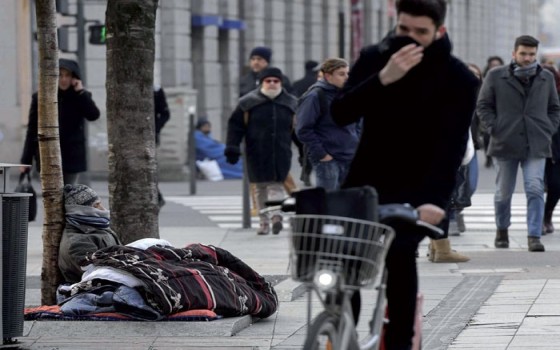
More than 1.9 million Belgians at risk of poverty or social exclusion

- Europe and Arabs
- Thursday , 5 February 2026 8:55 AM GMT
Brussels: Europe and the Arabs
Official figures in Belgium indicate that in 2025, 16.5% of the country's population was at risk of poverty or social exclusion, representing slightly more than 1.9 million people. This is revealed in the latest results of the Income and Living Conditions Survey (SILC) conducted by the Belgian statistics office (Statbel). We received a copy of the survey, which annually measures various indicators related to poverty, income inequality, and living conditions.
To be considered at risk of poverty or social exclusion (AROPE), a person must meet at least one of the following three criteria:
At risk of poverty (AROP): In 2025, 10.9% of the Belgian population had a disposable income below the poverty line.
Living in a low-work-intensity household (LWI): 11.0% of the population lived in a household where working-age adults had worked very little in the previous twelve months (i.e., less than 20% of their total potential).
Suffering from severe material and social deprivation: 4.9% of the population suffers from severe material and social deprivation, meaning they are unable to cover some of the daily expenses necessary to maintain a decent standard of living (such as paying bills, replacing worn-out furniture, and taking regular trips, etc.).
As in previous years, significant regional disparities persist:
The Brussels-Capital Region has the highest levels of poverty and social exclusion.
Flanders has the lowest percentages across all indicators.
Wallonia falls somewhere in between, but its poverty levels are higher than the national average. Over the years, these four indicators have shown somewhat divergent trends:
The AROPE index fell from 20.1% in 2019 to 18.3% in 2024, and then to 16.5% in 2025.
The LWI index was 12.9% in 2019, then fell to 11.4% in 2024, and then to 11.0% in 2025.
The SMSD index was 6.2% in both 2019 and 2024, then fell to 4.9% in 2025.
The AROP index fell from 14.8% in 2019 to 11.4% in 2024, and then to 10.9% in 2025.
These indicators are calculated based on a sample (SILC survey) representative of the population at both the Belgian and regional levels. Since this is a sample, the margin of statistical error must be considered when generalizing the results to the entire population. For these indicators, no statistically significant difference was observed between 2024 and 2025. However, the decrease in the AROPE and AROP indices between 2019 and 2025 is statistically significant.
Risk of Monetary Poverty
The poverty level continues to rise, reflecting the overall increase in average per capita income in Belgium. This level will now be €18,780 per year, or €1,565 per month (compared to €1,522 in 2024). For a family of two adults and two dependent children, this monthly amount will be €3,287, compared to €3,197 in 2024. Despite the increase in the poverty threshold, the monetary poverty rate will not rise, increasing from 11.4% in 2024 to 10.9% in 2025. This can be explained, among other things, by the increased income of some families due to linking wages and pensions to the inflation index. It is important to note that measuring poverty risk is relative: raising the poverty threshold does not necessarily mean an increase in the poverty rate.
Subjective Poverty
A person is considered subjectively poor when the head of the household indicates that the family has difficulty, or even extreme difficulty, in covering its basic expenses.
This approach is based on families' perception of their financial situation and therefore does not rely on a predetermined income threshold. In this sense, this indicator provides additional information to objective poverty indicators, as it highlights perceived financial constraints, which do not necessarily correspond to measured monetary poverty. Individuals' perception of subjective poverty is determined by their living conditions, financial burdens, aspirations, and what is considered normal in their social environment.
In Belgium, 15.5% of the population was at risk of subjective poverty in 2025. Comparing this indicator with the four key indicators mentioned earlier reveals significant overlap. Among those at risk of poverty or social exclusion, 50.2% reported being poor. This figure rises to 48.7% among those at risk of monetary poverty, 53.6% among those living in low-work-intensity households, and 85.7% among those experiencing severe material and social deprivation. Thus, subjective poverty appears to be closely linked to material and social deprivation, although income level plays a crucial role, as evidenced by the distribution across five income brackets. Furthermore, subjective poverty exhibits similar variations to those observed in other forms of poverty based on the following key socio-demographic characteristics:
There are clear regional differences, with a higher prevalence in the Brussels-Capital Region (29.4%) compared to Wallonia (21.9%) and Flanders (9.4%).
Employment status is a significant differentiating factor: 9.1% of employed individuals experience subjective poverty, compared to 39.3% of the unemployed and 27.1% of the economically inactive.
Family type plays a significant role: subjective poverty is more common among individuals living alone (20.5%), particularly in single-parent households (28.1%), compared to households with two adults (under 65 years of age) (11.3%). Finally, educational level is closely related to subjective poverty, with its rate being higher among individuals with a low educational level (25.2%) compared to individuals with an average educational level (16.4%) or a high level (8.1%).






No Comments Found