
Following a Gulf-European Ministerial Meeting: Condemnation of Iranian Attacks, Reaffirmation of the GCC States' Right to Self-Defense, and the Importance of Protecting Regional Airspace, Maritime Routes, Freedom of Navigation, and Energy Security

- Europe and Arabs
- Thursday , 5 March 2026 13:47 PM GMT
Brussels: Europe and the Arabs
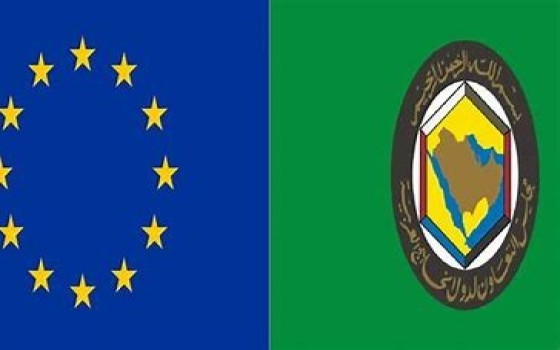
A statement issued by the European Union institutions in Brussels reads: “The foreign ministers of the Gulf Cooperation Council (GCC) and the European Union held an extraordinary meeting on March 5, 2026, to discuss the escalation in the Middle East and Iran’s unjustified attacks on GCC countries.
The ministers emphasized the importance of the strategic partnership between the EU and the GCC, established under the 1988 Cooperation Agreement and renewed at the EU-GCC Brussels Summit in October 2024.
The ministers strongly condemned Iran’s unjustified attacks on GCC countries, which threaten regional and global security, and called on Iran to immediately cease its attacks.
The EU reiterated its solidarity with the GCC countries.
The ministers reaffirmed their commitment to regional stability and called for the protection of civilians, full respect for international law and international humanitarian law, and adherence to the principles of the UN Charter.
The ministers recalled that they have repeatedly urged Iran to curb its nuclear and ballistic missile programs and refrain from destabilizing activities in the region.” The region and Europe, and an end to the horrific violence against its people.
The ministers discussed the grave damage caused by the recent indiscriminate Iranian attacks on the Gulf Cooperation Council (GCC) states, which targeted civilian infrastructure, including oil installations, service facilities, and residential areas, resulting in material damage and threatening the security, safety, and lives of civilians.
The ministers commended the intensive diplomatic efforts undertaken by the European Union, its member states, and the GCC states prior to the attacks, as well as the latter's commitment not to allow its territory to be used to launch attacks against Iran.
The ministers reaffirmed their firm commitment to dialogue and diplomacy as the means to resolve the crisis, praising the constructive role played by the Sultanate of Oman in this regard, and emphasizing the need to restore regional stability and security.
The ministers recalled the inherent right of the GCC states, in accordance with Article 51 of the Charter of the United Nations, to defend themselves, individually and collectively, against Iranian armed attacks. They affirmed that the GCC states have the right to take all necessary measures to defend their security and stability, protect their territories, and safeguard their citizens and residents in order to restore international peace and security. The ministers noted the responsibility The UN Security Council is responsible for restoring and maintaining international peace and security.
The ministers agreed to pursue joint diplomatic efforts to achieve a lasting solution that prevents Iran from acquiring nuclear weapons, halts the production and deployment of ballistic missiles, drones, and any technologies that threaten the security of the region and beyond, and prevents any destabilizing activities in the region and Europe, ultimately enabling the Iranian people to determine their own future.
The ministers reaffirmed the importance of protecting regional airspace, maritime routes, and freedom of navigation, including in the Strait of Hormuz and Bab el-Mandeb, as well as the safety and security of supply chains and the stability of global energy markets.
The ministers stressed that the security and stability of the Gulf region are fundamental pillars of global economic stability and are closely linked to European and global security.
In this context, the ministers acknowledged the importance of the EU's maritime defense operations Aspidis and Atalanta in protecting vital waterways and mitigating supply chain disruptions, and encouraged coordination to support these operations. The ministers also emphasized the need to protect regional airspace and maritime routes, as well as Energy security and nuclear safety.
The European Union expressed its gratitude to the Gulf Cooperation Council (GCC) countries for their hospitality and assistance to EU citizens on their territories. The EU and its Member States will continue to do their utmost to ensure the safe departure of their citizens, in close cooperation with the GCC countries.
The GCC side was headed by His Excellency Dr. Abdullatif bin Rashid Al Zayani, Minister of Foreign Affairs of the Kingdom of Bahrain and current Chairman of the GCC Council of Ministers, with the participation of His Excellency Jassim Mohammed Al-Budaiwi, Secretary-General of the GCC, and the foreign ministers of the GCC member states. The European side was headed by Her Excellency Kaja Kallas, High Representative of the European Union for Foreign Affairs and Security Policy and Vice-President of the European Commission, with the participation of Her Excellency Dubravka Šucca and the foreign ministers of the EU member states.




No Comments Found