

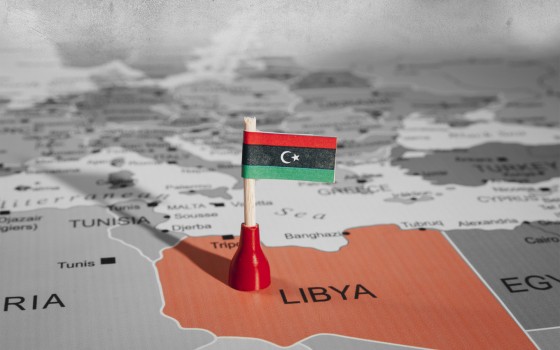
The Libyan Public Prosecutor's Office has identified three suspects directly involved in the assassination of Saif al-Islam Gaddafi.

- Europe and Arabs
- Friday , 6 March 2026 10:13 AM GMT
Tripoli: Agencies
The Libyan Public Prosecutor's Office announced the successful identification of three suspects directly involved in the assassination of Saif al-Islam Gaddafi, son of the late Libyan leader Muammar Gaddafi, who was targeted at his home in the city of Zintan in early February.
Authorities confirmed the issuance of immediate arrest warrants for the suspects, while keeping their identities and nationalities confidential. This was reported by the Brussels-based European news network Euronews on Friday.
In a detailed press release issued Thursday, the Public Prosecutor's Office revealed that investigation teams had precisely tracked the perpetrators' movements hours before the crime.
The investigation revealed that the suspects held a preparatory meeting at a specific, identified location before traveling in pre-determined vehicles along a carefully planned route to the outskirts of Zintan, located 145 kilometers southwest of the capital, Tripoli, where the assassination took place. According to the prosecution's account, based on field evidence, the team that carried out the attack had been monitoring Saif al-Islam at his residence. They then managed to infiltrate the courtyard and corner him in a small area.
At a crucial moment, the attackers unleashed a barrage of bullets using automatic rifles, resulting in direct hits that penetrated his body and caused his immediate death at the scene.
Conflicting accounts exist regarding the number of perpetrators.
In contrast, Saif al-Islam's political team, representing his French lawyer, offered a slightly different account in terms of numbers, stating that the operation was carried out by a group of four masked gunmen.
The source indicated that the raid occurred in broad daylight, with the attackers disabling the security cameras before entering. A brief exchange of fire with the site's guards took place moments before Saif al-Islam's death.
The political team called for an independent international investigation to uncover the masterminds behind the operation, asserting that the perpetrators were merely part of a larger scheme. A volatile political trajectory from reform to international prosecution
Saif al-Islam Gaddafi (53 years old) is one of the most prominent figures who shaped the Libyan landscape in the last decade. He previously headed the Gaddafi Foundation for Human Rights and launched the "Libya of Tomorrow" reform project, which saw the release of a number of political prisoners.
However, this moderate image collapsed with the outbreak of the 2011 revolution, when he threatened protesters with what he called "bloodbaths," making him a target of subsequent legal prosecution.
Following the fall of his father's regime, Saif al-Islam remained detained for many years by the Abu Bakr al-Siddiq Brigade in Zintan, which repeatedly refused to hand him over to either the judicial authorities in Tripoli or the International Criminal Court, which is pursuing him for crimes against humanity committed during the suppression of the 2011 protests. Despite a death sentence issued against him by a Libyan court in Tripoli in 2015 on charges related to war crimes, the brigade controlling Zintan released him in 2017 based on a controversial general amnesty law issued by the parliament based in the east of the country.
Attempted Political Comeback and the Stalled Elections
After his release, Saif al-Islam remained out of the public eye for years before breaking his silence with a surprise appearance in the southern city of Sabha in 2021. There, he submitted his candidacy papers for the presidential elections in person, relying on the support of former regime loyalists. However, this move was thwarted by the postponement of the elections, which have yet to take place. This crime comes at a time when Libya is experiencing a sharp political division and an ongoing power struggle since 2011, with two main institutions vying for legitimacy: the internationally recognized Government of National Unity in Tripoli, headed by Abdul Hamid Dbeibah, and a parallel government in Benghazi headed by Osama Hammad.




No Comments Found