
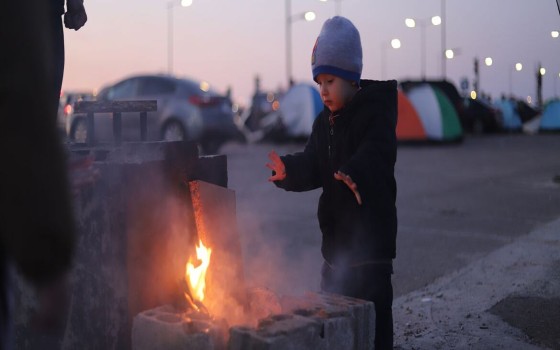
The current war in the Middle East is killing and injuring more than 2,000 children – an average of 87 children per day… Limited humanitarian response amidst growing needs

- Europe and Arabs
- Tuesday , 24 March 2026 4:16 AM GMT
Tehran – Beirut: Europe and the Arabs
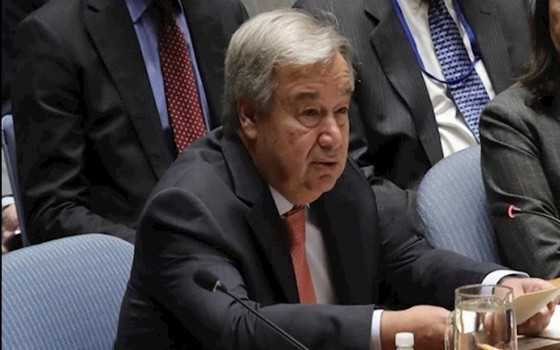
More than 2,100 children have been killed or injured in the Middle East during the 23 days of escalating conflict – including 206 children in Iran, 118 in Lebanon, four in Israel, and one in Kuwait – according to UNICEF Deputy Executive Director Ted Chaiban, who warned that these numbers are likely to rise as the violence continues. This information was included in the UN's daily news bulletin, a copy of which we received this morning, Tuesday.
"This means an average of about 87 children killed or injured every day since the start of the war," Chaiban said, emphasizing that children in the region are paying a heavy price and that any slide into a wider and longer-term war would be catastrophic for millions more.
He called on all parties to exercise maximum restraint and protect civilians at all times, adding: "Schools are not targets. Hospitals are not targets. Children are not targets." The UN official's remarks came during a press conference in New York on Monday, following his return from a visit to Lebanon.
A Class of Children Killed Every Day in Lebanon
In Lebanon, he noted that 118 children had been killed and 372 others injured since the escalation began, saying, "If you add these two numbers together, it's equivalent to an entire class of children being killed or injured every day."
The UN official said that behind these numbers are "parents, grandparents, teachers, brothers, sisters, communities, cities, and countries in a state of shock," amid widespread displacement resulting from the bombing and evacuation orders.
According to UNICEF estimates, up to 3.2 million people have been displaced in Iran, while more than one million have been displaced in Lebanon, including 400,000 children, representing nearly a third of the displaced population. Around 90,000 Syrians have also returned to Syria since the conflict began, along with thousands of Lebanese.
Sheiban noted that some 44.8 million children were already living in conflict-affected areas before the current war began, warning that "the consequences of what is happening now will be long-lasting for them," as homes, schools, and hospitals are damaged or destroyed, and health systems teeter on the brink of collapse.
Additional Layers of Suffering in Lebanon
In Lebanon, Sheiban described the situation as dangerously deteriorating, pointing out that the country is already grappling with a series of crises, and that the current escalation "is adding profound layers of impact on children."
He said, "For the families we met, this is the second time in 18 months that they have been forced to flee."
He explained that between 200 and 350 public schools are currently being used as shelters, disrupting the education of some 100,000 students. He added, "Schools offer more than just education… they provide order, protection, and continuity," warning that their closure deprives children of essential elements of stability. Ted Chaiban recounted the story of a young girl he met in Beirut: “I met Fatima, 15, who fled with her family from the south to the same school they had sought refuge in 18 months earlier. She told me that the night before we met, she had stayed awake listening to the shelling of Beirut’s southern suburbs, worried about her family, her friends, and her future. She and many others long to return to their homes and schools.” Limited Humanitarian Response Amid Growing Needs
Chaiban emphasized that UNICEF and its partners have scaled up their response, reaching 151,000 displaced people in over 250 shelters and providing water and sanitation services to 188 shelters serving approximately 46,000 people.
Nearly 13,000 children received educational materials, and 14 children with critical injuries requiring urgent surgical intervention were treated. Food and health assistance was also delivered to thousands of families in southern Lebanon, despite access challenges. But the UN official stressed that "the scale of the need is increasing at a faster pace than the available resources," especially with more than a million people displaced in a short period.
In this context, he referred to the UN's urgent humanitarian appeal for $308 million, explaining that UNICEF's share of this appeal is $48.2 million for three months, but the funding gap is approximately 85%.
Urgent Call for Action
Shaiban concluded by calling on the international community to take three immediate actions:
A ceasefire and the protection of civilians and civilian infrastructure;
Ensuring safe, rapid, and unhindered humanitarian access;
Providing urgent financial support to sustain the response.


No Comments Found