

UN General Assembly Adopts Historic Resolution Aimed at Making the International Organization More Effective, Cohesive, and Better Prepared to Deliver in a Changing World

- Europe and Arabs
- Wednesday , 1 April 2026 7:35 AM GMT
New York: Europe and the Arabs
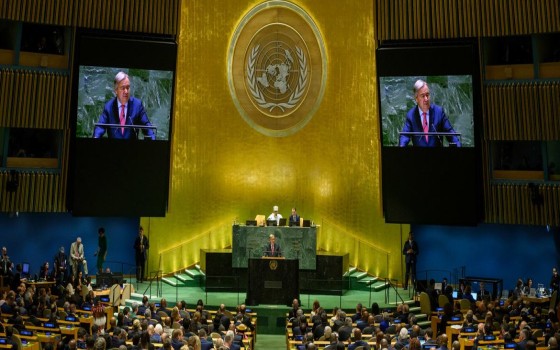
The United Nations General Assembly adopted a significant resolution to strengthen the process of developing, implementing, and reviewing the mandates that member states grant to UN bodies to guide their work.
This step represents a milestone within the framework of UN80, a comprehensive reform effort aimed at making the United Nations more effective, cohesive, and better prepared to achieve results in a changing world. This was reported in the UN Daily News, a copy of which we received Wednesday morning.
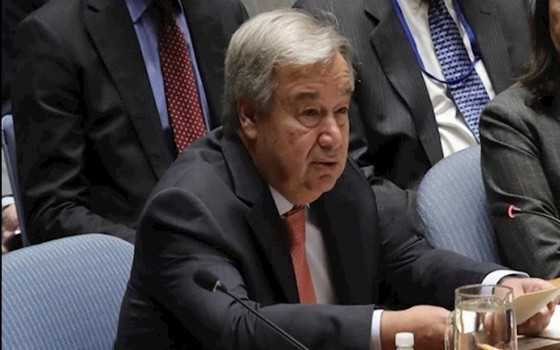
UN Secretary-General António Guterres, in his address to the General Assembly Hall on Tuesday, welcomed the resolution, describing it as a "historic decision" and a "significant step."
He told member states: "The resolution adopted today reflects a shared understanding of the full mandate cycle and a shared commitment to strengthening every step of it. Today's resolution helps translate the ambition of UN80 into concrete, practical action."
The Importance of Mandates
By establishing mandates, member states guide the entire system on how to address global challenges: from supporting peace and security and providing humanitarian assistance, to driving development and protecting human rights. Over time, the sheer number of mandates has created practical challenges.
Since 1946, more than 40,000 resolutions and presidential statements have been adopted across the main UN bodies, creating an increasingly complex environment.
This has contributed to duplication and overlap, a proliferation of reports and meetings, and limited transparency and review mechanisms across the system.
This can place a heavy burden on both Member States and the UN system, making it difficult to ensure the effective implementation of mandates.
A More Structured Approach
For the first time, this resolution introduces a more structured approach that encompasses the entire mandate lifecycle—from design to implementation and review.
What this means:
Clearer and more focused mandates, supported by better information for decision-making from the outset;
Stronger and more coordinated implementation, with improved data use, more user-centric reporting, and more efficient use of resources;
More systematic review of outcomes, helping to ensure that mandates remain relevant and deliver the intended impact, and fostering a culture of continuous improvement based on evidence, accountability, and results. Increased transparency through enhanced digital tools, including an expanded registry of UN mandates, providing Member States with more standardized and comparable information on mandates, resources, and outcomes.
Importance of the Resolution
The resolution aims to facilitate Member States' engagement with the increasingly complex mandate environment, while helping the UN reduce duplication, fragmentation, and inefficiencies.
By strengthening how mandates are designed, implemented, and reviewed, the resolution aims to improve how the UN system translates resolutions into results.
Next Steps
The resolution builds on the work of the General Assembly's Working Group on Mandate Implementation Review, co-chaired by Jamaica and New Zealand.
The General Assembly established the Working Group to consider the proposals contained in the Secretary-General's July 2025 report on mandate implementation review, prepared under the second track of the UN 80 Initiative. The report addressed how mandates are formulated, implemented, and reviewed within the UN system and offered proposals to strengthen each stage of the mandate lifecycle.
The resolution mandates the establishment of a formal, dedicated task force on mandate implementation, open to all member states and observers. The task force's responsibilities include, for example, developing better operational models, more rigorous review criteria, and conducting further reviews of existing mandates.
"This is an important step, but it is just the beginning," said Guterres. "We will work as one cohesive organization—guided by the task force—to improve how we support and implement mandates." He emphasized that the process remains member-led.
General Assembly President Annalena Baerbock said the adoption of the resolution represents an important step in a broader reform effort and called on member states to continue engaging in the next phase of work.
"Today we have taken an important step toward making the United Nations more resilient, efficient, effective, and future-ready, so that it can better serve the people we serve," she said. UN 80 Initiative
This resolution is the latest important step in the UN 80 Initiative. The Secretary-General launched this initiative a year ago to create a comprehensive impact across the UN system, ensuring that every mandate, every dollar, and every resolution delivers maximum value for humanity and the planet.
Next Monday, the General Assembly will hold an informal meeting to review the latest developments on the UN 80 Initiative Action Plan, including proposals currently being implemented.



No Comments Found