

Escalating tensions in southern Lebanon threaten the reopening of the Strait of Hormuz. The EU foreign policy chief is on a crucial tour of the Gulf states, and the White House is considering sanctions against NATO.

- Europe and Arabs
- Thursday , 9 April 2026 7:34 AM GMT
Brussels: Europe and the Arabs
"Reopening the Strait of Hormuz Sparks a Middle East Crisis" - Under this headline, an analysis by Playbook, the European edition of Politico, states: Efforts to reopen the Strait of Hormuz are facing a threat, casting a shadow over a global economy heavily reliant on this vital strategic waterway. The reason is the renewed escalation of tensions in southern Lebanon, some 1,500 kilometers from Tehran.
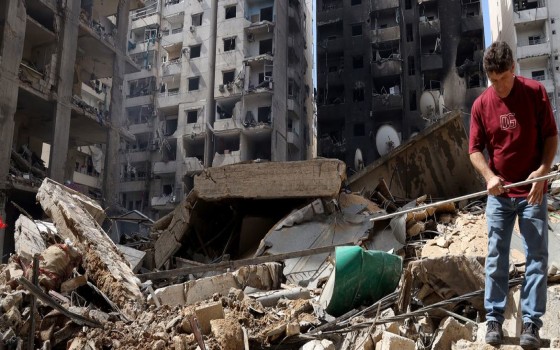
What happened: Hours after the United States and Iran announced a ceasefire, Israel launched a new wave of airstrikes, targeting Tyre and Nabatieh, as well as the Lebanese capital, Beirut. Israel claims it is targeting Hezbollah infrastructure and that it maintains positions on the ground in some areas.
The significance: The crux of the matter lies in the differing interpretations of the ten-point ceasefire plan. Pakistani Prime Minister Shehbaz Sharif (who brokered the agreement) says the plan includes Lebanon, a view shared by several international leaders, including Ursula von der Leyen and European Council President António Costa, who issued a statement yesterday.
Don't be naive: Israel insists The United States maintained that Lebanon was never part of the two-week ceasefire agreement. From Budapest, U.S. Vice President J.D. Vance described it as a “legitimate misunderstanding,” saying that Iran “thought” Lebanon was included “but it wasn’t—we never made that promise.” Vance warned that it would be “foolish” for Tehran to end the ceasefire over this.
But here’s what’s happening: Iranian Parliament Speaker Mohammad Baqer Qalibaf, along with Iranian Foreign Ministry spokesman Esmail Baghaei, accused the United States of “prematurely backing out” and violating the 10-point proposal negotiated by Sharif, particularly the section outlining the scope of the ceasefire. Reuters quoted Qalibaf as saying that under the current circumstances, “a bilateral ceasefire or negotiations are unreasonable.”
We expected this: “This situation was predictable,” according to an EU official who requested anonymity to speak freely to Playbook. The official warned that the escalation is “very dangerous” and could lead to an “unprecedented escalation” reminiscent of 1982, when The Israeli invasion led to the creation of a "security zone" in southern Lebanon.
Europe is concerned: Israeli forces reportedly detained a Spanish UN peacekeeper and fired warning shots at an Italian aid convoy. Madrid and Rome demanded answers and simultaneously issued sharp diplomatic criticisms of Israel. Spanish Prime Minister Pedro Sánchez said that Israeli Prime Minister Benjamin Netanyahu's "contempt for life and international law" was "unacceptable," while Italian Foreign Minister Antonio Tajani warned of "a second Gaza."
Israeli concern: Beirut should have dealt with Hezbollah, and since it didn't, Israel will. This is the message in a State Department post about the ceasefire agreement. The Wall Street Journal reported that Netanyahu was upset about not being informed of the agreement (a claim denied by the White House), while Felicia Schwartz of Politico wrote that Israel greeted the ceasefire with more concern than relief.
A double-edged sword: A diplomatic source from the region, speaking to Playbook, described Wednesday as "the worst day of the war." Describing it as "unprecedented," the source added that the central question is Israel's ultimate goal: "Destroying the Lebanese state will not stop Hezbollah." But if the goal is to occupy territory, this portends another, prolonged occupation. Or perhaps something else: Another EU official suggested a different motive: Netanyahu might be trying to derail the ceasefire altogether. And if that is the plan, he might succeed: Iranian media are reporting that the Strait of Hormuz is being closed. Brussels is watching: The European Commission has begun to respond. Commissioner for the Mediterranean, Dubravka Šuić, was the first to issue a statement on the ceasefire agreement, followed by Commissioner for Humanitarian Aid, Haja Lahbib. At a press conference, European Commission spokesman Anouar Alanouni described the attacks on the UNIFIL force in Lebanon as “unacceptable” and urged respect for Lebanon’s sovereignty. This signals escalating tensions between Israel and the EU. Focus on the Gulf: Kaya Kallas’s silence on Lebanon is noteworthy. The EU’s foreign policy chief visited Saudi Arabia yesterday and is in the UAE today, where she is expected to meet with Foreign Minister Sheikh Abdullah bin Zayed Al Nahyan, among other officials. Years of work at risk: While the focus appears to be on the Gulf, The current EU is focused on its Gulf partners, and a diplomatic source says Brussels—along with its international partners—must become more outspoken about Lebanon and push for a resumption of negotiations. An EU official said, “There seems to be a lack of focus on Lebanon, a kind of indifference. Lebanon remains a fragile country. Progress is being made, but there is a risk of years of effort being lost.”
Rutte Visits Washington
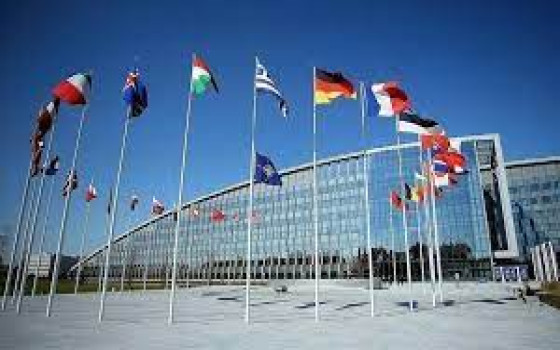
A Charming Offensive: Donald Trump’s meeting with NATO Secretary General Mark Rutte appears to have done little to quell the US president’s anger toward his allies. Trump entered the private meeting hinting that he was considering withdrawing from the transatlantic alliance after NATO members ignored his call to join a war against Iran, according to the Associated Press.
After the meeting, Trump posted a message on social media in all caps: “NATO.”
They weren't there when we needed them, and they won't be there if we need them again. The president also emphasized that he still remembers a previous conversation with Rutte, in which the NATO secretary general managed to deter a potential US invasion of Greenland. "Remember Greenland, that big, poorly managed iceberg!"
On a positive note, Rutte moved directly from the White House meeting to an interview with CNN, saying that in a "frank and open discussion," the president expressed his disappointment. The NATO secretary general added that he was able to remind Trump that "the vast majority of European countries have been cooperative, whether in providing military bases, logistical support, or air cover." He also said there is "broad support [in Europe] for the fact that degrading Iran's nuclear and ballistic missile capabilities is critical, and that the United States alone is capable, at this stage, of doing so." Punishing NATO: The White House is considering a plan to retaliate against certain members of the military alliance whom Trump believes provided no assistance to the United States and Israel during the Iran-Iraq War, according to a report in The Wall Street Journal. The proposal suggests withdrawing U.S. troops from the targeted NATO countries and redeploying them to more supportive nations. This measure falls short of the complete withdrawal the United States has threatened from the alliance.


No Comments Found