

Washington Seeks Gulf Readiness for a Potential War with Iran: Deployment of Patriot Systems, Troop Movements, and Rearmament in the Middle East—Amid Developments in Yemen, Southern Lebanon, and the West Bank, and the Outcome of the Israeli Elections.

- Europe and Arabs
- Wednesday , 28 October 2026 7:25 AM GMT
Tehran–Washington: Europe and the Arabs
Amidst the escalation in the Middle East, the region has witnessed simultaneous political and field developments across several fronts. In Israel, Knesset elections were held against a backdrop of persistent regional tensions.
Regarding Iran, U.S. President Donald Trump stated that Washington might launch further strikes against Tehran following the midterm elections, adding that "anything is possible"—though he stopped short of announcing a final decision to carry out a new military operation. According to a report by the Brussels-based news network Euronews, Iran stated that Trump admitted he never believed in the memorandum of understanding—a revelation that, according to Iranian Foreign Ministry spokesperson Esmaeil Baghaei, exposes Washington’s contempt for diplomacy. Baghaei added:
"Trump admitted that he never believed in the memorandum of understanding concluded in Islamabad, viewing it instead as a waste of time—which once again reveals Washington’s disdain for diplomacy."
"There is absolutely no justification for European nations and others who defend Washington to continue whitewashing the United States' misconduct or shielding it from accountability."
"Violating commitments cannot be justified, and international law must not be applied selectively."
"No amount of political narrative manipulation can absolve Washington of accountability."
In Yemen, clashes continue on multiple fronts between the Houthis and government forces, coinciding with ongoing Saudi-led airstrikes.
In southern Lebanon, the Israeli military carried out two explosions in the towns of Khiam and Talousa, according to the official National News Agency.
In the West Bank, a Palestinian man was injured after being beaten by settlers, while Israeli forces arrested another Palestinian following a pursuit of local residents and farmers in Masafer Yatta, south of Hebron.
The news website "Walla" reported that Israeli Defense Minister Israel Katz is holding consultations with Chief of Staff Eyal Zamir to discuss developments regarding Iran—at a time when Western media outlets have circulated reports suggesting the possibility of an imminent American strike on Tehran.
The United States has requested... The United States, in coordination with several Gulf Arab states, is preparing for the possibility of a short, intense military campaign against Iran following the U.S. midterm elections. Meanwhile, U.S. forces in the region are bolstering their air defenses and replenishing ammunition stockpiles, according to *The Wall Street Journal*, citing informed sources and officials.
The newspaper reports that these moves are part of military preparations for a potential renewed escalation with Tehran, although U.S. President Donald Trump has not yet made a final decision to launch an attack. Sources indicated to the newspaper that Trump is leaning toward carrying out large-scale strikes against Iran after the elections, keeping the military option on the table alongside ongoing efforts to reach an agreement.
As part of these preparations, the U.S. military is deploying a Patriot air defense system from Texas to strengthen its missile defense capabilities. It has also repositioned forces, moving personnel away from bases deemed more vulnerable in the event of a new confrontation. U.S. forces stationed in the region are replenishing their ammunition reserves, while bombers and fighter jets are being readied for potential strikes against Iranian targets.
According to the information reported by the newspaper, these measures suggest that Washington is preparing for a scenario of potential military escalation, taking steps to protect its forces and facilities in the region and minimize their exposure to any Iranian retaliation. However, these actions do not, in themselves, mean that a final decision to launch an attack has been made.
Trump Keeps the Military Option Open ...remains open.
This comes at a time when military options are intertwined with diplomatic efforts; reports suggest that the U.S. administration is still weighing two primary paths: launching new strikes or reaching an agreement with Tehran. According to The Wall Street Journal, Trump appears inclined toward a broad military option following the election, though this inclination has not yet crystallized into a formal, definitive decision.
Any new attack would likely trigger a fresh phase of escalation between Washington and Tehran—a particularly significant risk given the presence of U.S. forces in the region, whose bases and facilities could become targets for an Iranian response. Consequently, measures to bolster air defenses and redeploy forces have become critical components in preparing for any potential confrontation.
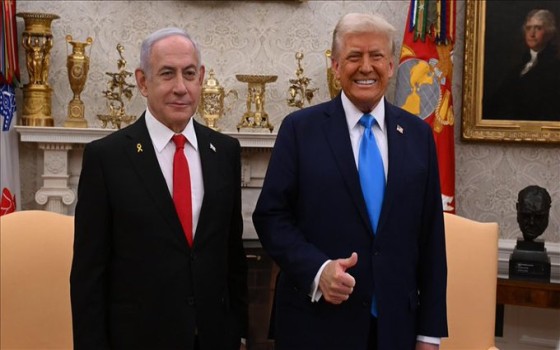
In parallel with these reports, Israeli Prime Minister Benjamin Netanyahu stated that Israel has averted what he described as an "existential threat." He asserted that the strikes targeting Iran have weakened the country, shifting the balance of power in Israel’s favor.
Netanyahu added that, in his view, the continued existence of the Iranian regime means the confrontation is far from over, as Tehran will inevitably attempt to destroy Israel once again. He affirmed that his country would work in coordination with U.S. President Donald Trump to definitively eliminate the Iranian threat.
Netanyahu characterized the current moment as a "historic and limited opportunity" to neutralize the Iranian threat—a stance that underscores the Israeli government’s commitment to maintaining pressure on Tehran, regardless of the potential regional repercussions that further escalation might entail.
These statements align with reports from The Wall Street Journal... ...[as reported by] the *Journal* regarding Washington’s preparations for a potential new military operation; however, these reports do not, in themselves, confirm that a final American decision has been made or that a definitive timeline for an attack exists.
These developments have brought the U.S.-Iran standoff into a phase of heightened anticipation, characterized by intensifying military preparations and calls from Israel to maintain pressure on Tehran—even as the possibility of reaching an agreement remains on the table. Should Washington decide to carry out further strikes, the nature, duration, and potential targets of such an operation will be key factors in determining the trajectory of any escalation. Furthermore, the redeployment of forces and the reinforcement of air defense systems reflect a need to prepare for a possible retaliation, though this does not constitute definitive proof that a confrontation is imminent.
As of now—based on information from the newspaper report and statements attributed to both Trump and Netanyahu—the central question remains: will the U.S. administration shift from a posture of military readiness and political pressure to the execution of a new attack, or will it move toward a settlement with Iran?



No Comments Found