
Strengthening the Role of Religious and Traditional Leaders in Combating Hate Speech and Building Peace: A Key Topic at the Muscat Plan Forum in Oman

- Europe and Arabs
- Monday , 16 November 2026 5:48 AM GMT
Muscat – New York: Europe and the Arabs
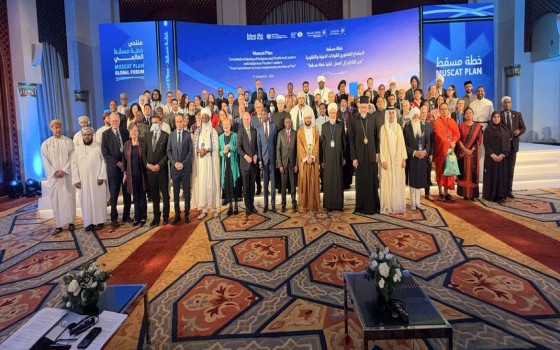
The global "Muscat Plan" forum has commenced in the Omani capital, Muscat. The event brings together UN officials, religious and traditional leaders, representatives of indigenous peoples, and youth from various nations to explore ways to strengthen the role of local communities in countering hate speech, preventing conflicts and mass atrocities, and translating international commitments into practical steps that support peacebuilding.
According to the United Nations’ daily news bulletin, the forum examines how to bolster the contributions of local leaders and youth in combating hate speech and preventing conflict. It also focuses on operationalizing the objectives of the "Muscat Plan"—launched in New York last June through a partnership between the Sultanate of Oman, the United Nations, and international stakeholders—at the local, regional, and international levels.
Held in conjunction with the International Day for Tolerance, the forum aims to foster a shared understanding of the Muscat Plan, facilitate the exchange of experiences and practices derived from local communities, and discuss mechanisms for cooperation between international partners, institutions, and community-based entities to support its implementation.
The Muscat Plan recognizes the vital role played by traditional leaders and indigenous peoples—as well as their respective leadership—in countering hate speech and preventing genocide, mass atrocities, and incitement to such acts, particularly through peace mediation. The plan is rooted in the value of local knowledge and community trust as essential tools for understanding challenges and enabling early responses to rising tensions. Local Leadership and Conflict Prevention
Speaking at the opening of a consultative meeting for religious, traditional, and indigenous leaders, Dr. Mohammed bin Said Al-Maamari, Minister of Endowments and Religious Affairs of the Sultanate of Oman, underscored the vital role these leaders play in preventing conflict and countering hate speech and incitement to violence. He emphasized the necessity of empowering them to participate effectively in mediation and peacebuilding efforts.
Al-Maamari stated that peace is not achieved merely through the cessation of conflicts or the signing of agreements; rather, it is built upon trust, shared values, and a society’s capacity to manage its differences without allowing them to escalate into hostility.
He explained that religious, traditional, and indigenous leaders possess a deep understanding of their own communities, as well as the credibility and trust required to reach segments of society that formal mechanisms may not be able to engage as effectively. He highlighted their role in reconciling individuals, de-escalating tensions, and preserving social harmony.
Al-Maamari added that the current moment requires moving beyond merely acknowledging the importance of these leaders toward empowering them to fulfill their roles in a sustainable manner. He stressed that "what we need today is for the legitimacy of institutions to be complemented by the trust of communities, and for specialized knowledge to converge with inherited wisdom."
Al-Maamari noted that the Sultanate of Oman’s hosting of this forum is an extension of its long-standing approach—one rooted in dialogue, mutual understanding, and respect for diversity—reaffirming that the responsibility for building peace is shared among societies, states, and international institutions. Also speaking at the opening session, Mr. Chaloka Beyani—Special Adviser to the UN Secretary-General on the Prevention of Genocide—discussed the role played by traditional and indigenous leaders in preventing violence and mass atrocities. He underscored the importance of involving them in efforts to counter hate speech and incitement.
Countering hate speech must begin before violence erupts
For her part, former Finnish President Tarja Halonen emphasized that intolerance and hate speech deepen divisions and erode trust within societies. In the most extreme cases, they can incite violence and lead to the commission of atrocities. She stressed that prevention efforts must begin long before conflicts break out.
In her address to the forum, Halonen stated that countering hate speech starts at the local level and within daily interactions, through the respect for diversity and the acceptance of differences. She explained that words shape human relationships; hate speech can gradually render discrimination acceptable and turn neighbors into enemies.
She added that religious, traditional, and indigenous leaders play a pivotal role in peacebuilding, thanks to their deep-rooted ties to their communities, the trust they command, their local knowledge, and their experience in dialogue, mediation, and conflict resolution. She called on these leaders to stand up for groups targeted on the basis of their identity, beliefs, or ethnic background. Halonen commended the Muscat Plan’s focus on empowering women and youth and involving them in conflict prevention and peacebuilding efforts. She highlighted the role women play in maintaining social cohesion during wars and conflicts, as well as the fresh ideas, energy, and perspectives that young people can contribute toward building a sustainable future.
It was emphasized that implementing the plan requires close cooperation among governments, local communities, international institutions, religious and traditional leaders, and civil society organizations—all grounded in mutual respect and the leveraging of each party’s unique strengths.
"Hate speech can make discrimination appear more acceptable, gradually turning neighbors into enemies," it was noted, underscoring that words matter, as does the way we speak about others. Everyone was urged to embrace courage and tolerance, and to work together to foster peace and prevent violence.
Indigenous Peoples and Ancestral Knowledge
The forum’s discussions also highlight the role of Indigenous peoples in supporting coexistence and protecting human rights, as well as the value of drawing upon ancestral knowledge to address societal challenges.
Sonia Astua Mahen Pardave, an advisor on women’s affairs and a representative of Indigenous organizations, explained that the philosophy of these peoples is rooted in reciprocal giving, gratitude, and respect for all forms of life. She stressed the importance of listening to diverse voices and respecting collective decisions.
Pardave—an Indigenous leader from the Quechua people of the Wanka nation—explained that protecting rivers, forests, and mountains, and preserving the environment, is a responsibility toward future generations. She emphasized the importance of tapping into the wisdom of elders and strengthening connections within the community.
"Harming others is harming oneself," she stated, pointing to the interconnectedness of communities and the necessity of respecting the rights and dignity of others. She added that indigenous peoples practice peaceful resistance through community organization, spirituality, and the legal defense of their rights, emphasizing that defending one’s rights does not require resorting to violence.
Youth as Partners in Peacebuilding
As part of the forum’s activities, a training program titled "Oman’s Harmonious Ties" is being held, featuring young men and women from over 20 countries. This specialized course focuses on religion and mediation, aiming to enhance the participants' skills and expertise in dialogue and conflict resolution.
Mohamed Elsanousi, Executive Director of the Network for Religious and Traditional Peacemakers, stated that the young participants in the program are already actively engaged in peacebuilding and mediation within their own communities. They bring with them experiences, insights, and leadership skills that contribute to fostering dialogue and establishing sustainable peace.
Among the participants is Florencio, a young man from Colombia who has spent nearly a decade working to promote the active participation of underrepresented groups in various forums, particularly within intergovernmental processes.
Florencio believes that young people play a pivotal role in building a more peaceful world. While they are among those most affected by conflict, they are also uniquely capable of devising solutions and contributing to social cohesion.
He noted that young people work to develop solutions—starting from the local community level and extending to political and economic spheres—thereby helping to create conditions that allow people to live in peace and fostering greater understanding within society. Also participating in the program is Kelly Kitchidjian, a young Lebanese woman studying international relations and political science, who works with organizations active in the fields of youth engagement and human rights.
She explained that the course covered topics such as gender-based violence and gender norms, as well as a conflict analysis framework—a tool that helps in systematically understanding the causes and components of conflicts, thereby supporting efforts in mediation, conflict resolution, and peacebuilding.
Reflecting on the experience of Lebanon, Kitchidjian highlighted both its rich cultural diversity and the challenges it faces—challenges that require the participation of all segments of society in the search for solutions. "We are not just children of Lebanon; we are children of the world," she said, emphasizing the vital role of youth in building a more peaceful future.
Children Talk About Peace
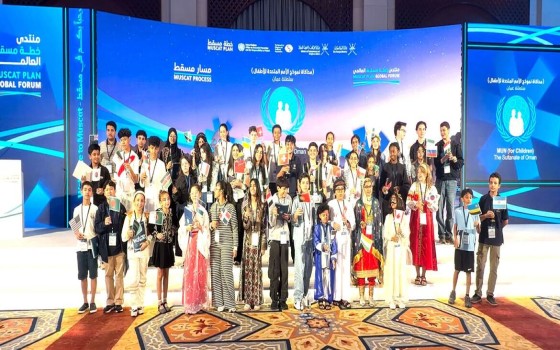
The activities accompanying the Muscat Global Agenda Forum included a Model United Nations (MUN) simulation for children. This program allowed students to learn about the work of the international organization and its various committees by assuming the roles of national representatives and debating global issues, including human rights, international peace and security, and sustainable development.
During the activity, participants were asked what first comes to mind when they hear the word "peace." While the children’s answers varied, they all converged on the importance of respect, coexistence, and resolving disagreements without violence.
A child named Mohammed stated that peace means "living together, respecting one another, and solving our problems without violence."
Joud, a student from the Modern International School, remarked that peace means respecting others and refraining from fighting; she encouraged her peers to avoid quarrels and to play together in peace.
Drawing for Peace
The children’s participation was not limited to discussions and simulations; it also extended to a drawing activity where they expressed their vision for peace and tolerance. Their artwork featured symbols advocating for the rejection of violence—most notably, the image of a knotted gun, which represents the principle of non-violence.
Among the participants was a young girl named Sarah, who, along with other children, was coloring a large poster bearing the phrase: "No to violence, yes to tolerance." Explaining the meaning behind these words, Sarah said, "The poster means that we should not be violent; we should be tolerant and not bully one another. I encourage all children to always practice tolerance, because tolerance is beautiful."
From Dialogue to Implementation
The Muscat Global Action Plan Forum is being held under the theme: "From International Commitment to Local Impact: Prevention and Peacebuilding." Its proceedings focus on three key areas: leadership and prevention; dialogue and social cohesion; and partnerships and implementation. The discussions and workshops aim to develop a global implementation framework and define practical steps at the regional, national, and local levels.
This initiative is part of a broader effort to foster cooperation among community leaders, governments, and international organizations, while facilitating the exchange of expertise and capacity-building—all with the goal of translating the principles of the Muscat Action Plan into tangible outcomes.
The plan emphasizes the importance of local communities serving as essential partners in prevention efforts. It asserts that responses must be grounded in an understanding of each community’s unique circumstances, experiences, and needs—while promoting dialogue, mediation, and trust-building as vital tools to prevent escalating tensions from spiraling into conflict.


No Comments Found