

The largest event of its kind in Europe. The fourth edition of the European Forum on Employment and Social Rights opens today, addressing good jobs, labor mobility, and changes in the labor market.

- Europe and Arabs
- Tuesday , 3 March 2026 5:34 AM GMT
Brussels: Europe and the Arabs
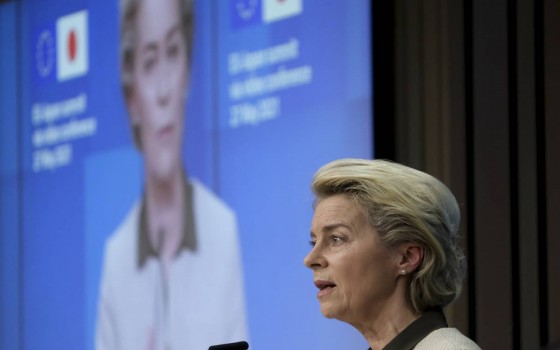
European Commission President Ursula von der Leyen, along with Vice-President for Social Rights, Skills, Good Jobs and Preparedness Roxana Menzatto, will open the fourth European Social Rights and Employment Forum, the largest event of its kind in Europe.
According to a statement issued by the Commission, this year's forum will be held in Brussels and online on March 3 and 4. The forum will address the EU's responses to challenges such as good jobs, the free movement of labor, and changes in the labor market.
Among the keynote speakers, both in person and remotely, are Enrico Letta, former Prime Minister of Italy; Vincent Kompany, head coach of Bayern Munich and founder of BX Brussels; and Sidsil Marie Christensen, CEO of the LEGO Foundation, as well as several national ministers and members of the European Parliament (full speaker list).
The statement also noted that on Tuesday, Vice-President Menzatto will host a dialogue on youth policies related to the cost of living. Participants will have the opportunity to share their experiences and ideas on how to build a more youth-friendly future for the European budget, addressing issues related to housing, employment, and the overall cost of living.
The Youth Policy Dialogue is part of the Commission's commitment to empowering young people's voices and involving them in EU policymaking. Key findings will be published in a comprehensive report following the dialogue.
According to a report published by Euronews in Brussels last September, the EU labor market is facing a growing crisis characterized by rising unemployment rates. Data from Eurostat, the statistical office of the European Communities, showed that 13.3 million people aged 15 to 74 were officially unemployed in the second quarter of 2025. However, this figure rises significantly to 26.8 million when considering what is known as "hidden unemployment." The standard definition of employment excludes three main categories: people available for work but not actively seeking jobs, the unemployed who are working part-time, and people seeking work but not immediately available. These groups, along with the unemployed, constitute what is known as a "labor market slump."
Varying rates across European countries
The labor market slump within the European Union reached 11.7% in the second quarter of 2025.
This figure combines 5.8% of the unemployed, 2.6% of those available for work but not actively seeking employment, 2.4% of the underemployed, and 0.9% of those actively seeking work but not immediately available.
Across 33 European countries, the slump rate ranged from 5.1% in Poland, which recorded the lowest rate, to 25.8% in Turkey, which topped the list.
Northern European countries such as Finland (19.5%) and Sweden (18.8%) also ranked among the highest, followed by Spain (18.6%). High rates were also observed in Bosnia and Herzegovina (17.1%), France (15.4%), and Italy (15%). The lowest rates were recorded in Poland, Slovenia, Malta, and Bulgaria, all of which remained below 6%.
The Position of Major Economies
Among the four largest economies in the European Union, Germany had the lowest labor market recession rate at 7.8%, the only rate below the EU average.
The other three economies—France, Italy, and Spain—joined the group of countries with the highest rates at or above 15%. It should be noted that the sum of the four variables that constitute labor market recession may vary slightly between countries in Eurostat data due to rounding or seasonal adjustments.
Drivers of Differences Between Countries
Dorothia Schmidt-Klau, head of the Employment, Labor Markets and Youth Branch at the International Labour Organization in Geneva, explained that there are four main factors driving these large differences in recession rates. The first is persistently high unemployment, which discourages people from looking for jobs, as many lack confidence that the system will help them find suitable employment. She said: “Decades of high unemployment have created a sense of futility in job hunting. When people believe their chances of finding suitable employment are slim, they often stop looking, even if they remain willing and able to work.”
The second factor is weak support systems, such as limited family care options and oppressive social norms, which explains the stark differences in labor force participation between Northern and Southern Europe. This is compounded by a lack of high-quality jobs that meet the aspirations and needs of job seekers. The fourth factor is skills mismatch. Some workers, after investing in education and training, discover that their skills don't match what companies are looking for, leading many to lose hope.
Available but not actively seeking work: After the unemployed, the category of people available for work but not actively looking is the second largest contributor to the stagnation of the European labor market. Data shows significant variations in the proportions of this group across countries, ranging from just 0.3% in the Czech Republic to 12.3% in Turkey.
Turkey is the only country where this rate exceeds the official unemployment rate of 8.6%. The rate is also relatively high in Italy at 6.6% and in Sweden at 4.4%. In contrast, it did not exceed 2.8% in Spain, despite the latter having the highest unemployment rate in the European Union.
Part-time Underemployment
Part-time underemployment plays a significant role in raising recession rates in many countries. The Netherlands topped the list at 5.1%, followed by Finland at 4.8%, and then Ireland at 4.7%. The rate also exceeded 4% in Switzerland, Turkey, and Spain, reflecting the scale of this problem in the European labor market.
Unemployment Accounts for a Third of the Recession
Data indicates that unemployment represents nearly a third of the total recession in the labor market in four countries: the Netherlands and Turkey (33% each), Ireland, and Switzerland (36%). This means that there are huge numbers of people who are not included in the official definition of unemployment who are contributing to deepening the recession, which highlights the importance of looking at broader figures rather than being satisfied with traditional unemployment statistics.








No Comments Found