
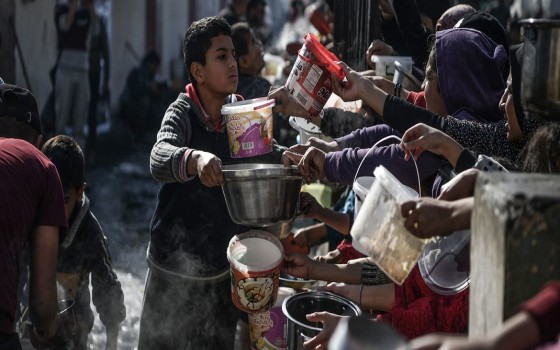
The crippling energy crisis hits the most vulnerable countries... Soaring prices will affect food, exacerbating the risk of hunger facing households.

- Europe and Arabs
- Friday , 10 April 2026 4:29 AM GMT
New York: Europe and the Arabs
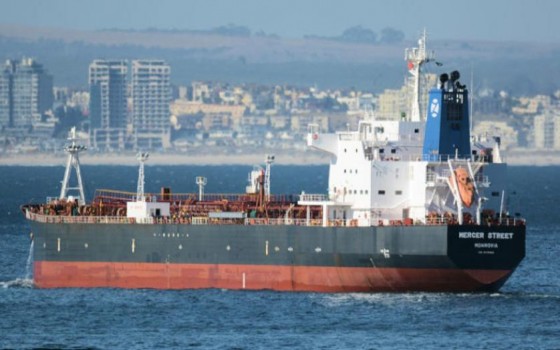
The war in the Middle East, and the accompanying near-total halt to shipping traffic in the Strait of Hormuz, has exacerbated the energy crisis facing developing countries in Africa and South Asia, which rely heavily on imports of liquefied natural gas, food, and fertilizers. According to the UN Daily News, “With Brent crude trading above $100 a barrel, many workers and families have returned to using oil and coal, raising concerns about lasting environmental damage. Meanwhile, several countries have already announced fuel rationing and a shift to online meetings. More than a month after the start of the Israeli-American bombing of Iran and the subsequent Iranian attacks that ignited a wider regional conflict, the near-immediate disruption of oil tanker traffic in the vital Gulf waterway has halted oil shipments worldwide, followed by disruptions to natural gas, coal, transportation services, food, and fertilizers. In this context, Junior Davis, head of the Policy Analysis and Research Branch in the Africa, Least Developed Countries and Special Programmes Division at the United Nations Conference on Trade and Development (UNCTAD), said: “Only a small group of least developed countries are net energy exporters: South Sudan, Angola, Chad, Mozambique, Laos, Myanmar, and Yemen.”
As for The vast majority of these countries are “net energy importers,” according to Mr. Davis, and include Niger, Zambia, Rwanda, Ethiopia, Tanzania, Madagascar, Togo, Sudan, Uganda, Nepal, Eritrea, Benin, Bangladesh, Cambodia, and Senegal.
Limited Gains for Oil Exporters
Highlighting the case of Angola, Davis noted that developing oil-exporting countries may reap only “limited gains” from these exports because “many lack domestic refining capacity, forcing them to re-import refined petroleum products at higher prices.”
Neighboring Zambia faces “even greater difficulties” due to its reliance on refined fuels imported from the Middle East, particularly the United Arab Emirates. Meanwhile, the least developed countries remain “heavily dependent” on imported fertilizers because fertilizer production relies heavily on natural gas (methane), as the economist explained. UNCTAD.
According to the UN Food and Agriculture Organization (FAO), 17 of the world’s poorest countries need to import more than 30 percent of their cereal requirements. Even more alarming is that the same number of least developed countries spend more than half of their export earnings just on food.
Mr. Davis stressed that “the implication is that higher energy prices will quickly pass on to food prices, exacerbating the risk of hunger for households.”
Limited Room for Action
Finding quick solutions to the energy crisis will not be easy, given the heavy debt burden weighing down many of the world’s poorest countries—an issue repeatedly criticized by UN Secretary-General António Guterres, who has urged financial sector reform to achieve equity, competitiveness, and growth.
Given the enormous debt burden many developing countries hold to foreign lenders, and the pressures they have faced on public spending for many years, the UNCTAD official said, “It is highly likely that households will have to pay more for energy and food.” And fertilizers, while reducing their consumption; The coming scene will not be pleasant at all.
Emergency Measures
Some countries have implemented emergency measures to address the crisis, including:
Bangladesh: Mandatory measures such as fuel rationing and electricity restrictions, including caps on air conditioning, refrigeration, and lighting, as well as the closure of universities.
Cambodia: Reduced energy consumption in the public sector, online meetings, limited government travel, lowered fuel taxes to help consumers, and stricter price controls at gas stations.
Ethiopia: Encouraged the rational use of fuel.
Myanmar: Fuel rationing, a rotational driving system (specific days for each vehicle category), and mandatory remote work for government employees.
Lao People's Democratic Republic: Implemented remote work and shift work for civil servants, launched public campaigns to promote the use of public transportation, rationed fuel, restricted transportation, and reduced fuel taxes and provided financial support.
Senegal: Appeals to households and businesses to conserve energy. In light of this alarming situation, UNCTAD noted that 15 of the world's least developed countries have not yet recovered from the years of turmoil caused by the COVID-19 pandemic, and their economies are still in a worse state than they were in 2019.



No Comments Found