
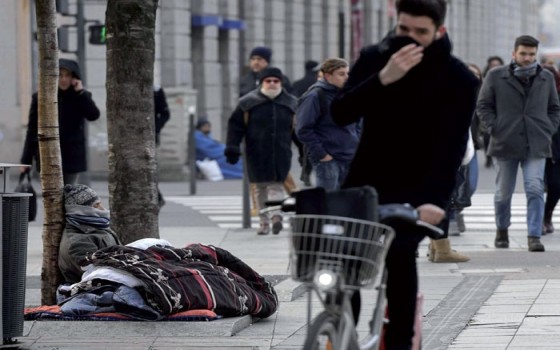
More than 90 million people in the European Union face the risk of poverty and social exclusion, particularly in Bulgaria, Greece and Romania.

- Europe and Arabs
- Sunday , 3 May 2026 6:9 AM GMT
Brussels: Europe and the Arabs
Official European figures indicate that in 2025, 92.7 million people in the European Union (20.9% of the population) were at risk of poverty or social exclusion. These individuals live in households experiencing at least one of the three risk factors for poverty and social exclusion: risk of poverty, severe material and social deprivation, and living in a very low-work-intensity household. Compared to 2024, the number of people at risk decreased by 600,000 (from 93.3 million, or 21.0% of the population).
This information is based on data on the rate of people at risk of poverty or social exclusion, published by Eurostat, the European statistical office in Brussels.
The highest percentage of people at risk of poverty or social exclusion was recorded in Bulgaria (29.0%), followed by Greece (27.5%) and Romania (27.4%). Conversely, the lowest rates were recorded in the Czech Republic (11.5%), Poland (15.0%), and Slovenia (15.5%).
The total population of the European Union is estimated at 450.7 million in 2025, according to the latest census figures and projections from Trading Economics. Looking back, in 1960, the EU had a population of 354.5 million.
The Union was established by an agreement known as the Maastricht Treaty, signed in 1992, but many of its core principles date back to the 1950s. One of the EU's key principles is the transfer of powers from nation-states to European institutions. However, these institutions remain subject to the powers granted by each individual member state, so the Union cannot be considered a federation, as it possesses a unique political system unlike any other in the world.
The European Union has many activities, most notably its status as a single market with a single currency, the euro, which has been adopted by 21 of its 27 member states. It also has a common agricultural policy and a common fisheries policy. In March 2007, the EU celebrated its 50th anniversary with the signing of the Treaty of Rome. On October 12, 2012, the European Union was awarded the Nobel Peace Prize for its contribution to promoting peace, reconciliation, democracy, and human rights in Europe.
On June 23, 2016, the United Kingdom voted in a referendum to leave the European Union, becoming the first member state to do so. The UK officially left the EU on January 31, 2020.




No Comments Found