

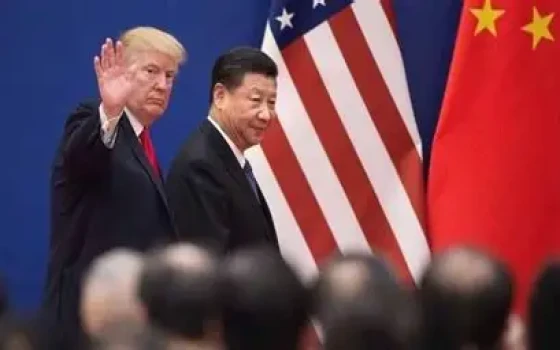
New Chinese Weapons on Their Way to Iran... Coinciding with Trump's Visit to Beijing... Europe, Japan, and Russia Await the Outcome of the Talks

- Europe and Arabs
- Thursday , 14 May 2026 8:29 AM GMT
Brussels: Europe and the Arabs – Agencies
Coinciding with Trump's visit to China, the first visit by a US president to Beijing in nearly a decade, The New York Times, citing US officials, reported that Chinese companies have entered into discussions with Iranian officials regarding potential arms deals. These discussions reportedly involved plans to transfer weapons through intermediary countries to conceal their true origin and complicate tracking.
According to US intelligence, the talks between the two sides included arrangements for arms transfers to Iran. However, US officials remain divided on whether any shipments have actually been sent or whether Chinese authorities have officially approved these operations. This information was reported by Euronews, the Brussels-based European news network.
Officials familiar with the matter indicated that one of the countries allegedly being used as a transit point for arms shipments is located in Africa, though there is no confirmation yet that any military equipment has reached that country.
Despite this information, US officials confirmed that they have not observed the use of Chinese weapons against US or Israeli forces since the outbreak of hostilities against Iran in late February, during the military operations targeting Tehran. In April, US reports revealed that intelligence agencies had detected indications that Beijing was preparing to supply Iran with shoulder-fired air defense systems—low-altitude anti-aircraft missiles—with evidence suggesting the shipments might be routed through other countries to conceal their origin.
Washington views these developments as a reflection of continued Chinese support for Iran during the war. The US accuses Beijing of providing Tehran with intelligence on US troop movements in the region, as well as supplying dual-use materials and components used in the manufacture of drones, missiles, and other weapons systems.
While US officials say they do not believe the Chinese government has given formal approval for the supply of finished weapons to Iran, they acknowledge it is unlikely that these contacts between Chinese companies and Iranian officials occurred without the knowledge of authorities in Beijing.
At the time, US President Donald Trump threatened to impose tariffs of up to 50% on Chinese goods if Beijing was found to be providing military support to Tehran. This prompted China to reaffirm its commitment to non-intervention and call for de-escalation. Iran Tops the Agenda
The release of this information coincided with Trump's visit to China, which began on Wednesday, the first visit by a US president to Beijing in nearly ten years. On Thursday, he met with Chinese President Xi Jinping and discussed several issues, including the war in the Middle East and bilateral relations.
The war in Iran and its repercussions on maritime security and energy supplies dominated a significant portion of the US-China talks. Washington sought to encourage Beijing to leverage its economic influence over Tehran, as the largest buyer of Iranian oil, to support de-escalation and the reopening of the Strait of Hormuz.
The talks also addressed the escalating trade tensions between the two countries, following Trump's threats to impose high tariffs on Chinese imports.
The two sides explored the possibility of establishing a new economic framework to mitigate the escalation, along with proposals to create a joint mechanism to monitor trade commitments and prevent a wider economic war that could impact the global economy.
On the issue of Taiwan, the Chinese president reiterated his country's opposition to any US military support for the island, considering the issue a "red line" for Beijing, especially after the recent US arms deal. The two sides also discussed the future of artificial intelligence regulation, focusing on establishing international controls for its military and security uses, amid escalating technological competition between Washington and Beijing.
Regarding the anticipation in Europe, Japan, and other parts of the world, media reports suggest that the summit's success could actually mean setbacks for Brussels, Tokyo, and others.
Matt Gertkin, chief strategist at BCA Research, said that a potential energy deal under which Beijing would agree to buy more US oil and natural gas could drive up global commodity prices. He added that any progress on trade—including Chinese commitments to direct investment in the US economy—could displace Japanese and European market share.
Russia is watching closely. The summit will be closely watched in Moscow, where Chinese support has become increasingly important. The last face-to-face meeting between Trump and Chevre last October prompted Russian officials to move quickly to reaffirm Moscow's alliance with Beijing. “Russia will be concerned about the overall improvement in US-China relations,” said Dennis Wilder, a former US intelligence official and professor at Georgetown University. Wilder said one likely outcome of the summit would be a reduction in Chinese support for Russia's war efforts in Ukraine.
Russian President Vladimir Putin is expected to visit Beijing next week, just days after Trump leaves office.



No Comments Found