

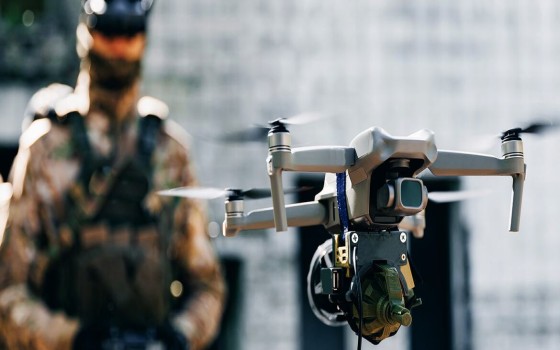
Autonomous Weapons – Renewed Call for Rules Before It's Too Late… Following the Use of Fully Autonomous, AI-Guided Drones on Battlefields

- Europe and Arabs
- Wednesday , 26 August 2026 6:20 AM GMT
Geneva: Europe and the Arabs
Amid unconfirmed reports of the use of fully autonomous, AI-guided drones on battlefields, the UN Secretary-General and the President of the International Committee of the Red Cross renewed their urgent call for stricter global rules before it is too late.
Key points:
The rules concern two types of autonomous weapons: those whose actions are “unpredictable,” and those that target humans.
Developments in artificial intelligence could diminish human control over the use of lethal force.
The call is for immediate negotiations on a legally binding instrument on autonomous weapons systems.
Failure to act swiftly and decisively will have human costs. According to the UN Daily News, which added under the headline “Approaching the Red Line,” the timing of this appeal reflects growing concerns about the development and deployment of increasingly sophisticated weapons at greater speed and range, supported by advanced AI technologies. Disarmament experts say that arms manufacturers themselves want the legal issues to be clear. In a joint statement, UN Secretary-General António Guterres and ICRC President Mirjana Spoljarić said: “We are now dangerously close to crossing a moral red line: the targeting of human beings by machines operating autonomously.”
Targeting civilians and civilian infrastructure in conflict zones is strictly prohibited under international humanitarian law. However, identifying non-combatants in conflict zones is often extremely difficult. The concern is that machines could make critical decisions without being able to distinguish between changing circumstances.
Legal and ethical principles: Melanie Regimpal, Head of Disarmament Affairs at the UN Office at Geneva, reiterated these concerns and the Secretary-General’s firm position that systems that select or target and take human lives without human oversight or judgment are “politically unacceptable, morally reprehensible, and must be prohibited under international law.” In Geneva, Laurent Geisel of the International Committee of the Red Cross (ICRC) described how the conflict is not just about precision, distinction, and restraint, but also about civilians being killed, families being displaced, and hospitals, schools, and homes being destroyed at an increasing rate and scale.
In such a context, “things can change very quickly,” Geisel explained. “A combatant can surrender or be wounded and thus be safe from attack. Civilians can enter the operational area of autonomous weapons systems and encounter an unforeseen situation.”
In their joint appeal, Guterres and Spoljaric noted that autonomous weapons “are not a technology of the distant future,” as the arms race to develop more autonomous weapons systems is already well underway.
They pointed out that the scientists and engineers developing these systems have expressed concerns about their risks.
The UN and the ICRC stressed that this year must be a turning point in this process. They urged governments to move beyond debate and begin negotiations on a legally binding instrument that sets clear limits. Guterres and Spoljarić said, “States must have the political courage to move beyond detailed discussions and take decisive action.” They warned that inaction could bequeath future generations a world where accountability for deadly decisions is difficult to establish.
This appeal comes ahead of the seventh Review Conference of the Convention on Prohibitions or Restrictions on the Use of Certain Conventional Weapons, scheduled for November in Geneva.
The Convention “seeks to alleviate the suffering caused by armed conflict by prohibiting or regulating the use of certain weapons that may be deemed to have excessively injurious or indiscriminate effects.” Guterres and Spoljarić described the conference as the clearest path available for States to agree to move forward with negotiations on a legally binding instrument.
They noted that significant groundwork for an agreement has already been laid through discussions in the UN General Assembly and the Group of Governmental Experts established under the Convention, including progress toward a shared understanding of the level of human discretion and control required, measures to ensure compliance with international humanitarian law, addressing relevant ethical issues, and reducing human suffering. The United Nations and the International Committee of the Red Cross (ICRC) first issued their joint appeal in 2023, calling on states to negotiate a legally binding instrument by 2026. Their statement at the time emphasized the need to maintain human oversight of life-and-death decisions and to prohibit, under international law, machines capable of taking lives without human intervention.
Tuesday’s appeal renews this urgent effort as the deadline approaches, stressing that the tireless work of recent years must now be translated into concrete action.
The UN Secretary-General and the ICRC President urged states “to seize this opportunity. Continuing to develop weapons systems that facilitate war will only undermine our collective efforts to build a more peaceful world.”
They stated that the path forward is clear, the need is urgent, and “innovations must be harnessed to serve humanity, not to endanger it.”
The joint appeal concerns a ban on two types of weapons:
Unpredictable autonomous weapons. These are weapons whose operators, whether by design or during use, cannot predict the outcome of the use of force.
Anti-personnel weapons. Although "all states" acknowledge that autonomous weapons in general raise ethical questions due to the lack of control over the use of force, concerns are highest regarding those that deliberately target humans, "because they reduce human life to mere data, algorithms, sensors, and automated processes," as Mr. Geisel, an expert with the International Committee of the Red Cross, stated.


No Comments Found