

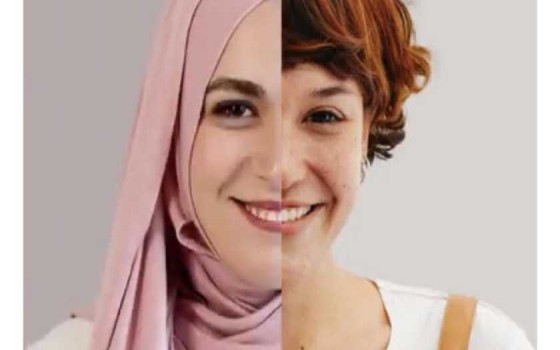
Dismissal of a teacher over the hijab reignites the debate on religious symbols in Belgium

- Europe and Arabs
- Tuesday , 15 September 2026 6:35 AM GMT
Brussels – Europe and the Arabs
Controversy has reignited regarding the targeting of women who wear the hijab in Belgium through decisions viewed by some as arbitrary and a violation of religious freedom, while others support dismissal from employment due to non-compliance with workplace rules and regulations applicable to everyone. Belgian media outlets have focused on this issue over the past few days; according to the daily newspaper *Het Nieuwsblad*, the province of East Flanders dismissed teacher Hadia Amajoud for refusing to remove her hijab at school. The provincial administration stated: "The entire provincial executive supports the principle of neutrality in schools." According to the ACOD union, this dismissal amounts to a personal vendetta.
What is happening?
Hadia Amajoud had been working as a teacher at the Kiempunt Campus Assenede school—a provincial special education primary school—since September 1, 2022. Two years into her appointment, the provincial administration issued new personnel regulations prohibiting teachers from wearing visible religious or philosophical symbols in the workplace, unless they were teaching a subject related to philosophy.
Amajoud felt targeted by this measure and refused to remove her hijab in the classroom throughout this period. Following numerous proceedings and discussions, she appeared before the East Flanders provincial disciplinary committee on September 3. The committee ultimately decided to dismiss her.
What is the situation in other provinces and across various educational networks? In the "GO! Community Education" program, a general ban on visible religious symbols for students and staff has been in effect since September 1, 2013. An exception is made for religious education classes: students are permitted to wear their religious symbols during these lessons, provided they remove them afterward—just as they would for a mathematics class, for instance. Teachers are also allowed to wear symbols associated with the specific religious subject they teach.
In municipal, city, and provincial education systems, the decision rests with the school administration itself. Consequently, rules may vary from one location to another. For example, the Antwerp city education authority prohibits students from wearing religious or philosophical symbols. The Antwerp provincial education authority enforces its own ban applicable to both students and teachers. In private education, too, each school board is free to make its own choice. In practice, very few Catholic schools allow female teachers to wear the headscarf. In 2024, the Catholic education authority in Flanders reported that fewer than one in ten Catholic schools permit female teachers to wear the headscarf.
Activists from an organization monitoring Muslim rights in Belgium advocated for teacher Hadia Amajoud during the court case concerning her decision to wear the headscarf in the classroom.
What is the position of the East Flanders provincial government?
Kurt Moens (of the New Flemish Alliance party), the East Flanders deputy responsible for provincial schools, declines to comment on the Amajoud case. However, he continues to support stricter personnel regulations, justifying this by stating: "We do not want to expose our students to cultural or religious pressures." "The entire provincial executive board (including Vooruit and CD&V) supports the principle of neutrality in schools. This principle applies to public education as well."
In this same context, the provincial executive board decided that, starting this academic year, students are no longer permitted to wear religious or philosophical symbols in provincial schools.
What the teacher says
Amajoud rejects her dismissal. She says: "For me, it doesn't stop there. It is not just a matter concerning my headscarf or me personally. For me, the issue is much broader; it concerns a fundamental right—the right to freedom of religious expression."
According to Amajoud, she repeatedly attempted to reach a compromise. For instance, she proposed replacing her headscarf with a turban or a bandana, but the province rejected this suggestion. Moens confirms that he does not support wearing a neutral uniform as an alternative to the headscarf.
What does the union say?
The Association of Teachers of the Province of Ontario (ACOD) will appeal the dismissal decision jointly with Amajoud. The union is deeply dissatisfied with the way the province has handled the case. Stefan Helfout of the union states: "This is a personal battle being waged by the provincial executive authority against a single teacher."
The union feels supported by the assessment of the Flemish Institute for Human Rights (VMRI), which investigated the case and ruled in Amajoud's favor. The Institute's final report details how a provincial deputy contacted Amajoud regarding her headscarf during a meeting in 2023—at a time when no ban was yet in effect. The Institute views this as an indication that the teacher was a victim of direct discrimination. The VMRI Institute report stated: "It is likely that a hostile, demeaning, humiliating, and harmful work environment was created for the teacher following the deputy principal's intervention."
How have judges ruled in the past?
Over the years, various courts have issued rulings regarding bans on religious symbols. A common thread among them is that the government or an educational network may, in principle, impose such a ban. A key condition is that the ban must cover not only the hijab but all visible religious symbols. According to legal precedent, exceptions for religious classes or religious instructors may be justified.
The VMRI Institute has already exonerated the teacher, Amagoud; however, the Institute is not a court of law and therefore cannot issue a binding ruling. In May 2026, the Ghent court ruled that no prohibited discrimination had occurred.
Asma Ouchan, former head of the Executive of Muslims of Belgium, commented on the matter on Facebook: "I watched the discussion on the program *De Afspraak* regarding the dismissal of Hadia Amagoud, and I realized how tired I have become of a single phrase:
'The ban applies to all religious symbols.' Perhaps in theory." During my time as head of the Islamic Council, I visited fourteen federal prisons. I remember many guards wearing open-collared shirts that clearly revealed a cross underneath. No one paid it any mind.
In fact, one of them even welcomed me at the entrance without making any attempt to button up his collar. No, that didn’t suddenly drive me to renounce Islam; I was actually happy for him, as he felt free enough to openly display his beliefs.
Yet, I have often reflected on that moment since: What if I had been standing there in that same federal uniform, but wearing my hijab? Would that display have been viewed with the same leniency? Perhaps that is precisely what troubles me so much about this debate.








No Comments Found