

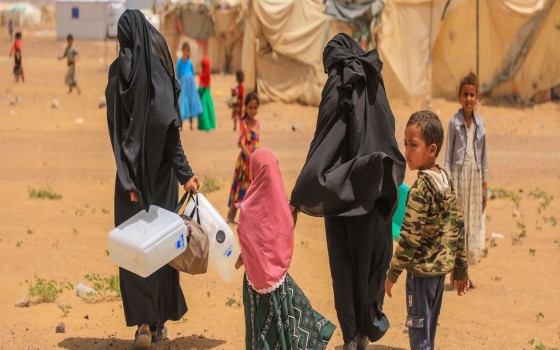
Dire conditions in Yemen, Gaza, and southern Syria due to hunger, disease, and conflict...

- Europe and Arabs
- Saturday , 10 October 2026 6:53 AM GMT
Gaza – Sana’a – Geneva: Europe and the Arabs
The ongoing fighting in Yemen is creating a "crisis within a crisis" for children in the country; families continue to flee while lacking the most basic necessities for survival, amidst rising malnutrition rates and the spread of disease.
According to UNICEF spokesperson Ricardo Pires, more than one-third of the children screened by the organization's mobile teams across eight governorates were found to be suffering from acute malnutrition.
Speaking at a press conference in Geneva on Friday, Pires noted that out of 10,625 children screened, 3,780 were suffering from acute malnutrition; cases of malnutrition were also identified among approximately 1,500 pregnant and breastfeeding women.
He added: "Beyond the immediate dangers posed by violence and displacement in Yemen, we are witnessing deeply concerning signs of a worsening health crisis for children, characterized by alarming levels of malnutrition and a sharp rise in disease outbreaks, all while access to healthcare diminishes."
Pires pointed out that cholera cases have tripled in just three weeks, while cases of dengue fever and malaria are also on the rise.
Meanwhile, an escalation of hostilities in the country's southwest has displaced more than 200,000 people across ten governorates since the beginning of September. UNICEF has verified the deaths of 28 children and injuries to another 25, alongside reports that three children are missing. Pierres noted that a frontline health worker supported by the organization described a scene of families "fleeing under fire, leaving everything behind, only to find themselves without food, water, or shelter."
He said: "He told us that displacement is exacerbating malnutrition among the children visiting his clinic. As he put it, access routes are completely cut off; there are shortages of cooking gas, petrol, and diesel; and basic food supplies are rapidly running out in local markets. He described the situation in the city of Taiz as horrific."
UNICEF’s mobile teams have provided approximately 12,000 health consultations across eight Yemeni governorates—treating children suffering from diarrhea and respiratory illnesses—while simultaneously continuing efforts to screen for and treat malnutrition, vaccinate children, and provide support to pregnant women.
Pierres concluded: "For the children of Yemen, the fighting creates a crisis within a crisis. Each new wave of violence makes their chances of survival increasingly precarious; we must act now." This follows a warning from UN Special Envoy for Yemen Hans Grundberg that the country has once again slid into all-out war, with hostilities expanding across multiple fronts in recent weeks. He called on all parties to protect civilians and renew efforts to launch a credible political process. In a briefing to the Security Council on Friday, Grundberg stated: "If recent developments prove anything, it is that the conflict in Yemen cannot be contained. Without a credible political process leading to a sustainable resolution, the conflict will continue to reignite, deepening regional tensions and threatening broader stability."
Grundberg noted that fighting has intensified in several areas of the country—including the highlands west and south of Taiz city and areas extending into Lahj Governorate, as well as the governorates of Marib, Al-Jawf, and Hajjah.
He explained that following an advance by the Ansar Allah group toward Al-Mocha and the coast along the Bab al-Mandab Strait, the Yemeni government launched a large-scale counter-offensive earlier in the week and subsequently reported regaining control of areas around Bab al-Mandab.
Meanwhile, the humanitarian situation is rapidly deteriorating in Taiz, Yemen’s most populous governorate. Aerial attacks, including airstrikes, also continue across the country. Condemnation of Attacks on Saudi Infrastructure
Grundberg joined the UN Secretary-General in condemning attacks launched by the Ansar Allah group against civilian infrastructure and the energy sector in Saudi Arabia—including recent strikes on Abha International Airport and King Khalid International Airport in Riyadh—which resulted in civilian casualties.
He reiterated his call for Ansar Allah to cease these attacks.
Intensive UN Consultations
Grundberg stated that he had spent the past month conducting intensive consultations with the Yemeni government and the Ansar Allah group, as well as with relevant regional and international stakeholders, including in Riyadh, Muscat, Cairo, and Washington, D.C.
He explained that there is broad recognition that Yemen stands at a pivotal moment—not only for its own people but for the entire region. He noted that ongoing instability in the Middle East impacts developments in Yemen, while developments within Yemen resonate across the region.
He stated that Ansar Allah’s threats against Saudi-linked commercial vessels in the Red Sea undermine freedom of navigation for all nations. He added that these threats have become increasingly intertwined with the broader confrontation over control of maritime trade routes and the pressures facing international energy markets.
Meanwhile, regarding Gaza, International Organization for Migration (IOM) Director General Amy Pope warned that the combined supplies of humanitarian shelter partners in the Gaza Strip cover barely 17% of winter needs, at a time when almost the entire population remains in need of shelter assistance a year after the ceasefire announcement. Popp emphasized that families who have already endured repeated displacement and devastating losses must be able to face the winter in safety and dignity, and that "shelter materials must be brought in quickly, regularly, and in the required quantities." The organization stated that, given the scarcity of available alternatives, many families are living in war-damaged buildings that pose grave risks to life.
In August, one of the organization’s partners identified more than 3,600 buildings as dangerous and at risk of collapse.
The organization warned that the intensifying El Niño phenomenon is expected to bring heavy rains that could further compromise the structural integrity of unsafe buildings, while severely damaged drainage systems leave communities vulnerable to flooding.
The organization and its partners working in displacement site management have identified approximately 1.8 million people living in such sites, the majority of whom are in areas at risk of flooding.
Supplies Ready for Delivery
The International Organization for Migration (IOM) reported that it currently has some 8,600 emergency shelter kits pre-positioned outside Gaza and ready for delivery; however, Israeli authorities continue to deny their entry at the crossings.
In the meantime, humanitarian teams are relying on locally available materials and on salvaging and reusing materials whenever possible.
The organization’s Director General emphasized that immediate and sustained humanitarian access is essential to save lives, repair damaged shelters, and help families move beyond temporary solutions. The organization called for the immediate and sustained entry of tents, emergency shelter kits, relief housing units, timber, tools, and other materials needed to repair shelters and damaged homes, as well as to support families seeking safer housing.
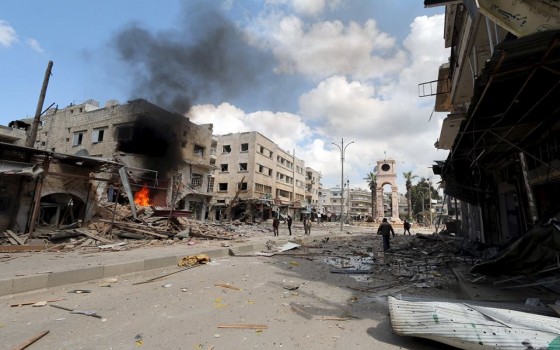
Regarding the situation in Syria, the Office of the UN High Commissioner for Human Rights (OHCHR) expressed concern over the continued impact of Israeli military operations on civilians in southern Syria. It called on Israeli authorities to halt "acts of harassment and intimidation," including raids, restrictions on freedom of movement, detention, and the destruction of crops.
At a press conference in Geneva on Friday, OHCHR spokesperson Shabia Mantoo stated that September saw approximately 280 incidents of Israeli military incursions into Syrian territory, marking "the highest monthly figure recorded since the beginning of the year."
These incidents included the shooting and temporary detention of a farmer with a disability—who was wounded in the leg—and the killing of a 22-year-old man in Quneitra.
Mantoo noted that her office continues to document cases of Syrians being detained by Israeli forces and has received information indicating that at least 49 Syrians remain in Israeli custody. She added: "Information from released detainees and other sources points to prolonged periods of detention—exceeding a full year in some cases—and a failure to inform detainees of the reasons for their detention, as well as transfers between multiple, undisclosed detention facilities and allegations of torture and ill-treatment. These allegations included beatings, forced standing for extended periods, the use of dogs against detainees, and threats of harm to them and their family members."
Mantu emphasized that no one may be detained without a valid legal basis under international law, stressing the need to treat all detainees in a manner that upholds their dignity and safeguards their human rights.
She also noted that High Commissioner Volker Türk had called for an urgent, impartial investigation into incidents resulting in civilian injuries or deaths, stating that "intentional lethal force may only be used when strictly unavoidable to protect life."







No Comments Found