

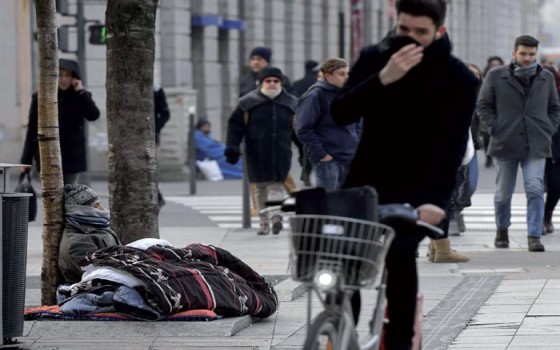
More than 16% of Belgium’s population face the risk of poverty and struggle with healthcare costs—yet they consume more fruits and vegetables. New data released to mark the International Day for the Eradication of Poverty.

- Europe and Arabs
- Friday , 16 October 2026 6:42 AM GMT
Brussels – Europe and the Arabs
Among individuals at risk of poverty or social exclusion, 53.9% live in households where healthcare costs represent a heavy or moderate financial burden. In contrast, this figure stands at 30.4% for the rest of the population.
This is one of the key findings released by the Belgian statistical office (Statbel) to mark the International Day for the Eradication of Poverty. The data are drawn from the "Health" module of the 2025 Survey on Income and Living Conditions, which covered more than 6,400 Belgian households.
According to a statement from Statbel—a copy of which was received—this module examines healthcare costs and utilization, daily functional abilities, physical activity, nutrition, tobacco and alcohol consumption, and Body Mass Index (BMI).
The findings are presented here at the individual level, distinguishing between those at risk of poverty or social exclusion (AROPE) and the remainder of the population.
The AROPE indicator encompasses individuals who fall into at least one of the following three categories: having an equivalized disposable income below the poverty line, experiencing severe material and social deprivation, or living in a household with very low work intensity. In 2025, 16.5% of the population fell into the AROPE category.
The financial burden of healthcare varies according to one’s poverty status.
The two groups differ significantly regarding the costs associated with medical care. Regarding medical care—excluding medication—18.6% of individuals at risk of poverty or social exclusion (AROPE) live in households that consider these expenses a heavy financial burden, compared to 8.5% of those not at such risk. Conversely, 46.1% of the AROPE group reported that these costs pose no financial burden at all, compared to 69.5% of the other group.
The same applies to the other two categories of expenditure:
Medication: 18.1% versus 6.5% consider it a heavy financial burden; 47.4% versus 73.2% report no financial burden.
Dental care: 18.7% versus 7.2% consider it a heavy financial burden; 56.2% versus 73.0% report no financial burden.
Regarding the utilization of healthcare, the disparity is most pronounced in the area of dental care.
Consulting a general practitioner (GP) does not follow the same logic regarding the cost of care. In 2025, 8.2% of individuals in the AROPE group had not consulted a GP during the preceding twelve months, compared to 9.2% in the other group; thus, the differences between the two groups are limited. The primary distinction between the groups lies in the frequency of medical consultations. For instance, 23.7% of individuals in the AROPE group reported having six or more consultations, compared to 18.0% of the other group. The same applies to visits to specialists: the proportion of individuals who did not consult a specialist is similar (38.3% versus 39.6%), while the proportion of those who consulted a specialist six or more times is higher in the AROPE group (14.7% compared to 10.1% in the other group).
The use of dental services, however, follows a different pattern. Among individuals with ADHD (AROPE), 34.6% did not consult a dentist over the past twelve months, compared to 18.7% in the other group—a difference of nearly 16 percentage points. These figures are lower for both groups than they were in 2022 (39.4% and 21.3%, respectively), a trend occurring against the backdrop of an overall increase in the use of dental services across the Belgian population (with 24.7% not using dental services in 2022, compared to 21.2% in 2025).
Daily Functional Challenges
This survey also assesses individuals aged 16 and older regarding six types of functional limitations. For five of these, there is a clear disparity between the two groups, with mobility showing the most significant difference. Among individuals with ADHD (AROPE), 71.5% reported no difficulty in walking or climbing stairs, compared to 85.4% of those without the disorder. Severe difficulties affect 11.9% of the former group and 5.0% of the latter. The same disparity is evident in the following areas:
Remembering things or concentrating: 81.6% of individuals with Attention Deficit Hyperactivity Disorder (ADHD) report no difficulty, compared to 90.2% of those without the disorder.
Vision—even when wearing glasses or contact lenses: 83.7% versus 89.9%.
Bathing and getting dressed: 89.4% versus 96.0%.
Communication: 92.0% versus 97.5%. Hearing is the exception here: 91.2% of the ADHD group and 90.9% of the comparison group report no difficulty with hearing—making the percentages nearly identical.
Physical activity: Less participation in sports during leisure time, but greater physical exertion during work.
Outside of work, 42.9% of individuals with ADHD engage in physical activity at least once a week, compared to 65.4% of others (the average in Belgium is 61.9%). Conversely, 49.3% of the ADHD group report no physical activity at all, compared to 27.0% of the comparison group. Both groups showed higher levels than in 2022 (when 37.7% and 61.8%, respectively, engaged in weekly physical activity).
The situation differs regarding physical activity during work. Among individuals in the AROPE group, 26.9% hold jobs that require long periods of sitting, compared to 49.5% of other individuals. Conversely, 21.4% are employed in jobs that demand significant physical exertion or strenuous labor, compared to 10.8% of the latter group. Nutrition: Vegetables and Fruit
In 2025, 46.7% of individuals at risk of poverty or social exclusion (AROPE) consumed fruit at least once a day, compared to 60.2% of those not in this category and 58.1% of the total population aged 16 and older. Conversely, 12.4% of the AROPE group consumed fruit less than once a week—or never at all—compared to 7.4% of those not in this category. Both groups show lower figures than in 2022 (when daily consumption rates were 50.3% and 63.8%, respectively). Vegetable consumption rates are higher across the board: 63.9% of the AROPE group consume vegetables daily, compared to 83.1% of those not in this category; the Belgian average is 80.0%. Vegetable consumption is limited to three times a week or less for 19.0% of the AROPE group, compared to 5.9% of the rest of the population. These proportions remain stable compared to 2022.
Tobacco, Alcohol, and Body Mass Index (BMI)
Tobacco: 22.3% of individuals at risk of poverty or social exclusion (AROPE) use tobacco or e-cigarettes daily, compared to 12.0% of those not in this category and 13.6% of the general population. In contrast, 74.3% of the AROPE group reported that they never use tobacco or e-cigarettes, compared to 85.2% of the others. These figures are very similar to those from 2022.
Alcohol: As in 2022, there is no difference in daily consumption, with 6.3% of the AROPE group and 7.7% of the others reporting daily use. The difference lies in abstinence: 50.8% of individuals in the abstinent group never consume alcohol, compared to 25.6% of those in the non-abstinent group. Conversely, 14.3% of the first group and 27.3% of the second group reported consuming alcohol a few times a week. As for the general population in Belgium, the rate of daily alcohol consumption has decreased from 9.2% in 2022 to 7.5% in 2025.
No Comments Found