
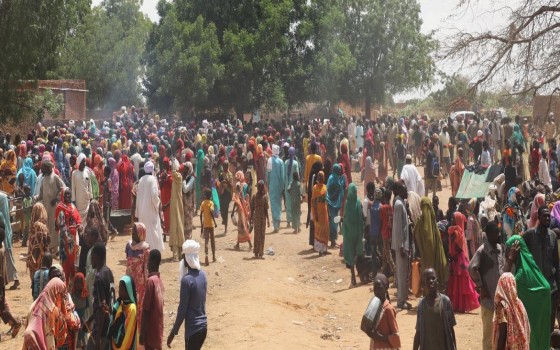
The situation in Sudan remains bleak: fighting continues, civilians are suffering, the humanitarian crisis is worsening, and essential services have collapsed—according to a senior UN official speaking before the Security Council.

- Europe and Arabs
- Saturday , 17 October 2026 5:32 AM GMT
Khartoum – New York: Europe and the Arabs
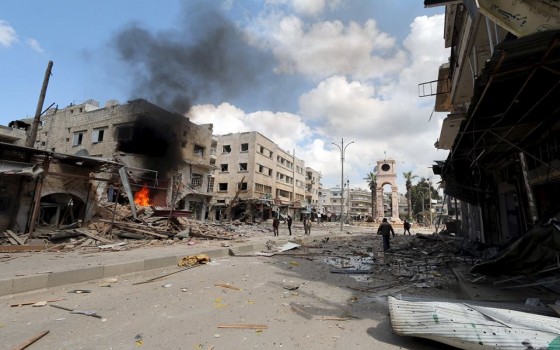
The situation in Sudan remains grim. The war continues to inflict immense suffering on civilians, characterized by ongoing fighting, drone strikes, and aerial bombardments, alongside a deepening humanitarian crisis and the collapse of essential services—as reported by a senior UN official to the Security Council.
In a briefing to the Security Council on Friday, Rosemary DiCarlo, Under-Secretary-General for Political and Peacebuilding Affairs, stated that the warring parties have yet to demonstrate a credible commitment to making concessions or negotiating a truce to halt the fighting.
Instead, she noted, they appear to believe that securing further gains on the battlefield—bolstered by continued external support—will enable them to achieve their objectives through force. This information was included in the daily UN news bulletin, a copy of which was received by our office.
DiCarlo emphasized the urgent need for the parties to reconsider their calculations, and she called upon all external actors to use their influence to end the war rather than fuel it further.
Urgent Measures to Protect Civilians
DiCarlo stated that the United Nations continues to coordinate with the "Quad" group—comprising the United States, the United Arab Emirates, Saudi Arabia, and Egypt—which is working toward an agreement on a humanitarian truce.
She affirmed the UN’s readiness to support the implementation of any such agreement. However, she stressed that international efforts cannot wait for a formal agreement to be reached before taking practical steps to curb the violence and alleviate the suffering of civilians. She stated that one possible immediate measure would be for the parties to the conflict to cease the use of drones, or, at the very least, to agree on specific commitments and implementation arrangements to strictly regulate their use.
She explained that drone attacks remain the primary cause of civilian casualties this year.
She affirmed the United Nations' readiness to work with the Quad—and other partners—to put forward additional proposals aimed at curbing violence, protecting civilians, and mitigating the humanitarian consequences of the war.
Practical steps to rebuild trust
In parallel with efforts to reduce the fighting, Pekka Haavisto, the Secretary-General’s Personal Envoy for Sudan, continues to engage with the parties to advance confidence-building measures and encourage more constructive interaction between them. DiCarlo noted that both sides have established committees to consider the unilateral release of detainees and to conduct negotiated prisoner exchanges.
Working in close cooperation with UNICEF, Haavisto is also engaging with the parties to ensure that a standardized, nationally recognized examination is made available to all Sudanese students.
This step would help ensure the continuity of education for an entire generation of young Sudanese, preventing their future opportunities from being dictated by the front lines of a war they did not choose. Discussions are also underway with Chadian authorities regarding arrangements for Sudanese students who are refugees in Chad.
"These initiatives demonstrate that practical progress remains possible, even in the midst of conflict," DiCarlo said. However, she stressed that "dialogue alone is not enough; the Sudanese people need to see results."
She called on the parties to translate discussions into clear commitments and concrete actions without delay, and urged member states to leverage their influence and resources to support these initiatives and help advance a broader political process.
Civilians demand an end to the war
Political efforts are also being pursued through the Personal Envoy of the Secretary-General and partners within the "Quintet" group—comprising the African Union, IGAD, the League of Arab States, the European Union, and the United Nations—who are supporting the efforts of Sudanese civilians to unite around a political future that reflects the aspirations of the Sudanese people.
In early September, senior officials from the Quintet visited Khartoum to hear directly from Sudanese stakeholders on the ground, including their perspectives on ongoing political initiatives.
Engaging with the widest possible spectrum of Sudanese women, youth, and other underrepresented groups remains a core focus of these efforts.
DiCarlo noted that one message was consistently echoed across these meetings: civilians want an end to the war and a return to civilian-led governance. She emphasized that political and security negotiations cannot proceed on separate tracks, as they are fundamentally interconnected and mutually reinforcing. She stated that the meeting of the Consultative Group on Sudan, to be held in Geneva next week—with the participation of the Quad, the Quint, and other key mediators—is set to provide a fresh opportunity to coordinate efforts, bridge gaps, and strengthen collective pressure in support of peace.
She noted that international engagement regarding Sudan is gaining momentum, but emphasized that this momentum must be matched by a clear commitment from the parties to cease hostilities and engage seriously in a political process.
A Year Since the Tragedy in El Fasher
Rosemary DiCarlo pointed to the approaching anniversary of the fall of El Fasher—the capital of North Darfur state—to the Rapid Support Forces. She urged the international community not to lose sight of the devastating humanitarian toll of the war, nor of the atrocities that have been, and continue to be, committed.
She stressed that preventing further atrocities requires more than mere expressions of concern; it demands concrete action and significantly greater pressure on the parties to the conflict, as well as on anyone who continues to enable, arm, fund, or provide political support to them.
"The parties to the conflict must also realize that accountability is not optional," she said. "The Sudanese people, who have endured unimaginable suffering, deserve peace and a credible path toward a better future." DiCarlo once again called on the Security Council to utilize all tools at its disposal to help bring an end to this devastating conflict.







No Comments Found