

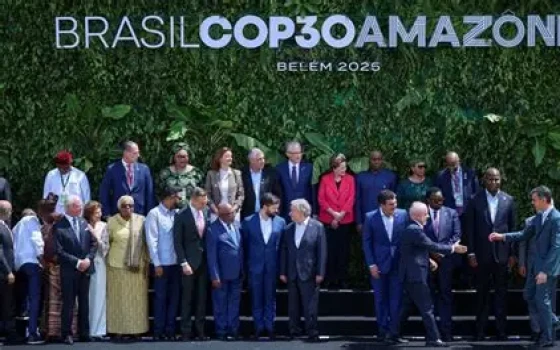
COP30 Climate Change Conference: A Call for Urgent Action and Translating Funding Pledges into Reality... Climate Insecurity Leads to Hunger and Poverty, Fueling Migration and Conflict

- Europe and Arabs
- Sunday , 16 November 2025 8:45 AM GMT
Belém, Brazil: Europe and the Arabs
As the world's attention turns to the Amazon, where the 30th Conference of the Parties (COP30) is being held in Belém, Brazil, one question looms large: Can climate finance move from mere pledges to reality?
At every negotiating table and in every diplomatic statement lies a stark truth shared by countries on the front lines of the climate crisis: without finance, there is no security, no justice, and no survival.
Many urgent actions are required to ensure a livable planet and protect millions of lives. But all of them—every achievement, every shield of resilience—depend on one fundamental engine: finance.
Discussions at the 30th Conference of the Parties to the United Nations Framework Convention on Climate Change (COP30) on Saturday centered on financial mobilization, or what leaders have called the engine of climate transformation. According to the UN Daily News, which added under the headline "A Matter of Survival," during the third high-level ministerial meeting on climate finance, the 30th Conference of the Parties (COP30) heard from representatives of countries severely affected by climate change, many of whom described access to financial resources as "a matter of survival."
In her opening remarks, UN General Assembly President Annalena Baerbock said that COP30 should mark the beginning of implementing the commitment to provide up to US$1.3 trillion in annual climate finance – which must "reach those most in need, quickly, transparently, and equitably."
In her opening remarks, she emphasized the need for climate action and social justice, noting that "climate insecurity fuels hunger and poverty, and poverty drives migration and conflict; conflict, in turn, exacerbates poverty and discourages investment." She said breaking this vicious cycle is essential to achieving global climate goals.
Renewable Energy Takes Center Stage
Speaking about the 10th anniversary of the Paris Agreement, Ms. Baerbock recalled that in 2015, many delegates were deeply moved by the historic outcome of the first legally binding global climate treaty, signed by more than 190 countries.
She noted that at the time, renewable energy was widely considered “unrealistic,” but today it is the fastest-growing energy source on Earth.
By 2024, global investment in clean energy reached $2 trillion, nearly $800 billion more than fossil fuel investments. Solar power has become the cheapest source of electricity in history.
Africa’s Untapped Potential
However, Ms. Baerbock cautioned that “enormous potential remains untapped because capital is still not flowing where it is most needed,” particularly in Africa.
More than 600 million Africans still lack access to electricity, even though the continent's renewable energy potential is 50 times greater than projected global electricity demand by 2040. Developed countries were urged to fulfill their technological and financial commitments and accelerate reforms to global financial institutions.
A "Lifeline" for Climate Action
UNFCCC Executive Secretary Simon Steel also addressed the meeting, emphasizing the transformative power of climate finance.
He described finance as "the lifeline of climate action," capable of turning "plans into progress" and "ambition into action." Mr. Steel stressed that the most vulnerable countries still face significant challenges in accessing long-promised funds.
"When finance flows, ambition grows."
Despite billions of dollars being invested globally in clean energy, resilience, and just transitions, Mr. Steel said the overall scale remains "insufficient and unpredictable," and is not being distributed equitably. The 30th Conference of the Parties urged demonstrating the effectiveness of climate cooperation, asserting that current investments can shape "the path to growth in the 21st century."
The UN's top climate official emphasized that "when finance flows, ambition grows," enabling the implementation of programs that create jobs, reduce the cost of living, improve health outcomes, protect communities, and ensure a more resilient and prosperous planet for all.





No Comments Found