

United Nations: Message to America and Israel: "It's time to stop the war that has spiraled out of control. Iran must stop attacking its neighbors." Personal envoy to lead efforts on the Middle East conflict: "Peace is the solution."

- Europe and Arabs
- Thursday , 26 March 2026 6:34 AM GMT
New York: Europe and the Arabs
The UN Secretary-General announced the appointment of Jean Arnault (France) as his personal envoy to lead UN efforts on the conflict in the Middle East and its consequences. He warned that the war was spiraling out of control. He called on the United States and Israel to end the war, and on Iran to cease its attacks on its neighbors.
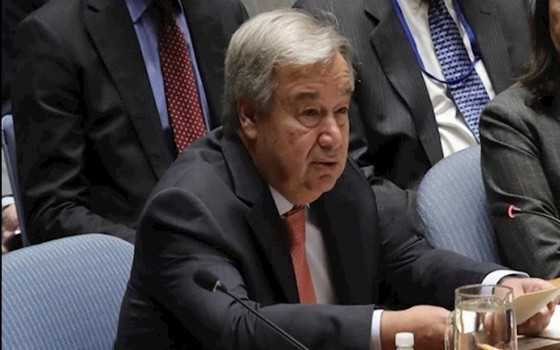
Speaking to reporters outside the UN Security Council chamber, Secretary-General António Guterres said the conflict had escalated beyond even the most seasoned leaders. He added, "It is time to stop the climb up the ladder of escalation, to start climbing the ladder of diplomacy, and to return to full respect for international law."
Guterres stated that he had been in contact with many people in the region and around the world over the past few weeks. He noted that several dialogue initiatives were underway and stressed the importance of their success.
After announcing the appointment of Jean Arnault as his personal envoy to lead UN efforts on the conflict and its consequences, he said, "My message to the United States and Israel is that the time has come to end the war, as the humanitarian suffering deepens, the number of civilian casualties rises, and the devastating impact on the global economy intensifies." Guterres added: “My message to Iran is to stop attacking its neighbors who are not parties to the conflict. The Security Council has condemned these attacks and demanded that they end, and has reaffirmed the need to respect freedom of navigation and rights around vital waterways such as the Strait of Hormuz.”
The Secretary-General said that the prolonged closure of the Strait is “strangling” the transport of oil, gas, and fertilizer at a critical time for the global planting season.
Guterres stated that civilians across the region and beyond are suffering severe harm and living in extreme insecurity. He noted that he had witnessed some of the consequences of this situation firsthand during his recent visit to Lebanon.
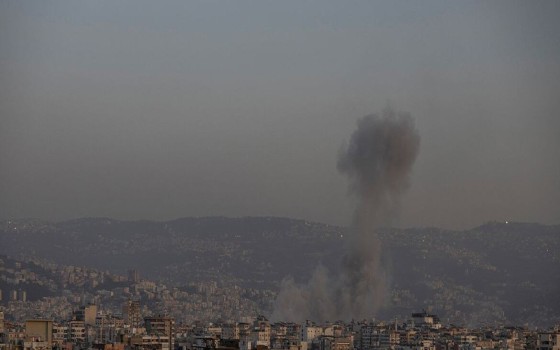
He stressed the need to end the war in Lebanon as well, saying: “Hezbollah must stop its attacks on Israel. Israel must stop its military operations and bombardments in Lebanon, which are having a disproportionate impact on civilians. The Gaza scenario must not be repeated in Lebanon.”
The Secretary-General pointed to the disruptions in markets worldwide, the undermining of humanitarian operations, and the disproportionate impact on the poor, the vulnerable, and those least able to withstand further shocks.
He said that the UN system continues to work to try to mitigate the consequences of the war, and that the best way to achieve this is to end the war immediately. He stressed that war is not the solution, emphasizing the need for peace, diplomacy, and full respect for international law to resolve the situation.
In response to journalists' questions about the role of his Personal Envoy, Guterres said that his envoy would do everything possible on the ground to support mediation and peace efforts, engage with all parties, and study the significant impact of the conflict in the region, manifested in the suffering of civilians, and globally, including its consequences for the global economy and its particularly severe repercussions for the least developed countries.
It is worth noting that the Personal Envoy, Jean Arnault, has nearly 40 years of experience in international diplomacy, especially in the areas of peaceful settlements and mediation. He also has extensive experience leading UN missions in Africa, Asia, Europe, and Latin America.
At the request of Bahrain, on behalf of the Gulf States and Jordan, the Human Rights Council held a rare emergency session to discuss the repercussions of the war in the Middle East, amid growing warnings of a deteriorating humanitarian situation in the region. The United Nations continues its efforts to end the war and provide support to mitigate its impact on civilians. The Human Rights Council adopted a resolution condemning Iran's "blatant attacks" on Gulf states and Jordan, demanding an end to "all unjustified attacks" against Bahrain, Kuwait, Oman, Qatar, Saudi Arabia, the United Arab Emirates, and Jordan.
Bahrain
Ambassador Abdullah Abdullatif Abdullah, Permanent Representative of the Kingdom of Bahrain to the United Nations and other international organizations in Geneva, stated that his country continues to be "subjected to unjustified military attacks by Iran in clear violation of the principles of the UN Charter and the rules of international law."
He explained that these attacks targeted civilian areas in his country and other countries in the region, "resulting in numerous civilian casualties and damage to civilian infrastructure, including vital facilities and service centers, despite the fact that our countries are not party to any conflict." The Bahraini ambassador stated that "targeting civilian objects and vital infrastructure constitutes a clear violation of international law, including the rules relating to the protection of civilians and civilian objects. It also directly infringes upon the enjoyment of fundamental rights guaranteed under international human rights law, foremost among them the right to life and the right to personal safety, as enshrined in the Universal Declaration of Human Rights."
He noted that these military attacks on his country "have disrupted public life, necessitating precautionary measures to protect the population, including, among other things, the transition to remote work in a large number of institutions."
Among the more than 65 countries that spoke at yesterday's session, Switzerland indicated its support for the resolution, stating, "We believe that Iran's attacks exceed the right of legitimate self-defense."
Indonesia pointed out the absence of any mention of the joint Israeli-American strikes on Iran that ignited the war. The delegation informed the Council, "The text omits any reference to the attacks launched by the United States and Israel against Iran, as well as the Israeli attacks on Lebanon, which continue to exacerbate the situation."
Iran's Permanent Representative to the United Nations in Geneva, Ambassador Ali Bahreini, stated during the emergency session that Israeli and American airstrikes had destroyed approximately 45,000 homes and targeted and bombed 53 hospitals and 57 schools, noting that "more than 1,500 people, including 300 children," had been killed.
The Iranian ambassador also mentioned the attack on a primary school in Minab on the first day of the war, which resulted in the deaths of approximately 150 people, including many schoolgirls.
The Iranian ambassador stated that the attacks on his country "are launched from American bases in some neighboring countries. Airports in those countries have become refueling stations for fighter jets that drop bombs daily on the Iranian people."
He added, "How can all this be happening while we trust our neighbors and friends, believing that they would not allow their land or airspace to be used to launch attacks on Iran?"
He spoke of his country's right to respond to the attacks, which he said were targeting Iran. He addressed a message to neighboring countries, saying: “We must unite for our shared values, our shared geography, and our shared future. We must stand together against what we consider the hostile schemes of our common adversary, Israel.”
Speaking at the emergency session of the Human Rights Council, Volker Türk, the UN High Commissioner for Human Rights, described the “chaos” currently engulfing the Gulf states, more than three weeks after the US and Israeli airstrikes on Iran.
He added: “The conflict is widening and intensifying in the region and beyond, and civilians are bearing the brunt. Families across the region celebrated Eid al-Fitr and Nowruz under bombardment, amid fear and uncertainty, and are now facing even greater hardship.” Emergency Session
The “urgent debate” held today at the Human Rights Council in Geneva is only the eleventh such debate since the Council’s establishment in 2006. Member states agreed to convene the meeting at the request of Bahrain, and on behalf of the Gulf Cooperation Council and Jordan, “to discuss the recent military aggression launched by Iran against Bahrain, Jordan, Kuwait, Oman, Qatar, Saudi Arabia, and the United Arab Emirates on 28 February 2006.”
Tomorrow, Friday, a second emergency session will be held at the Human Rights Council, at the request of Iran, to discuss “the attack on a school in Minab that killed 168 girls aged between 7 and 12.”


No Comments Found