

European Fears of the Repercussions of War in Iran: Efforts to Prevent the Energy Crisis from Turning into a Full-Scale Economic Crisis and the Exploitation of the Situation by Hardline Parties in the Upcoming Elections... Brussels: We Will Be Forced to Lower Expectations

- Europe and Arabs
- Monday , 27 April 2026 5:41 AM GMT
Brussels: Europe and the Arabs
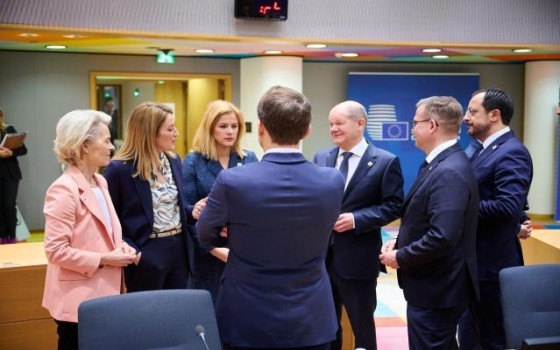
The Iranian shock is casting a long shadow. European Union leaders have remained neutral in the US-Israeli war against Iran, but they are struggling to avoid its repercussions, which are rapidly turning into a political nightmare for the fragile bloc.
Under the headline "Purely Economic Issue," Playbook, the European edition of Politico, reported that pro-European leaders, such as German Chancellor Friedrich Merz, are striving to prevent the energy crisis from morphing into a full-blown economic crisis and to stop their populist opponents from exploiting it against them at the ballot box.
Seamus Boland, president of the European Economic and Social Committee, told Playbook that voters suffering from the "income shock" caused by rising prices and weak growth may seek to punish current officials. He added: "Politically, this creates an environment of distrust, not only in national governments but also in the ability of European institutions to protect citizens from external shocks." Upcoming elections in Sweden, Cyprus, and the German state of Saxony-Anhalt—where the far-right Alternative for Germany party is currently leading the race—offer voters ample opportunity to voice their discontent.
Leaders may have hoped the Middle East crisis would end quickly, but there seems to be no end in sight to the standoff between Washington and Tehran, which has driven oil prices above $100 a barrel. While you were asleep, Axios reported that Iran had made a new proposal to reopen the Strait of Hormuz and end the war, while postponing talks on its nuclear program. However, Trump appeared in no hurry yesterday to send his negotiators back to Pakistan. Iranian Foreign Minister Abbas Araqchi has just arrived in Russia to discuss the war with Vladimir Putin.
Brussels has few options: the European Commission has put forward proposals to ease the burden on families and businesses, but the bloc's tools are limited, and Europe's economic situation is worsening. Valdis Dombrovskis, the EU's economic affairs commissioner, told Playbook that "we will almost certainly have to lower our economic forecasts" when the Commission publishes its spring forecasts in May.
The specter of war with Iran looms large over the agenda in Strasbourg this week as the European Parliament convenes, beginning with a debate on the EU's €1.8 trillion long-term budget on Tuesday. The debate is likely to devolve into a battle over the size and scope of the multiannual financial framework, with lawmakers seeking to allocate specific resources to support agriculture and cohesion funds. (Giorgio Liali's article on the budget talks at the leaders' summit on Friday is worth your time.)
The issue will resurface on Wednesday: European Commission President Ursula von der Leyen will join MEPs in a debate on the EU's strategy regarding the conflict in the Middle East and its economic and geopolitical ramifications.
Berlin Tightens the Noose on Brussels
Von der Leyen Feels Pressure from Her Party: The president of the European Commission is in Berlin today, where she faces pressure from her conservative party, the Christian Democratic Union (CDU) and the Christian Social Union (CSU), to accelerate the European Commission's efforts to deregulate.
Their Tactics: Drafts of a new strategy paper prepared by the conservative parliamentary group, obtained by Berlin-based Oliver Neumann of Playbook, reveal how German lawmakers are exerting increasing pressure to get what they want from Brussels. (Read Oliver's full report here.)
One striking proposal: placing the Commission under the supervision of a body with veto power over any legislation coming from Brussels. Plans to restrict the Commission's powers are unlikely to be implemented anytime soon, as they would most likely require amending the EU treaties. But the increasingly strident tone emanating from Berlin speaks volumes. With pressure mounting from the far right, the conservatives, led by Merz, have become more aggressive toward Brussels.




No Comments Found