

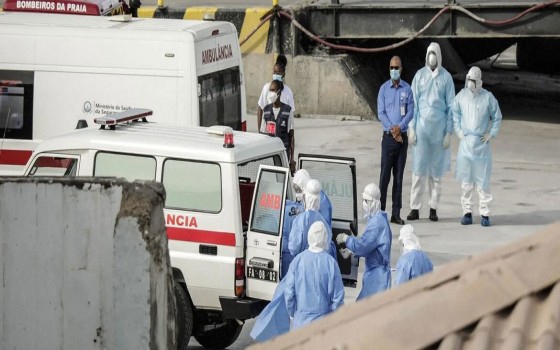
To combat the Hantavirus outbreak, European health authorities remain on high alert for new cases. Deaths and infections have been reported in the Netherlands, Switzerland, South Africa, and Spain.

- Europe and Arabs
- Friday , 8 May 2026 5:46 AM GMT
Brussels – Madrid: Europe and the Arabs
Spain has activated the European Civil Protection Mechanism in response to a Hantavirus outbreak on board the cruise ship MV Hondius, which is expected to arrive in Tenerife in the coming days.
Spanish Interior Minister Fernando Grande-Marlaska announced that the decision was made "out of humanitarian concern," emphasizing that the situation is "complicated but under control."
The outbreak, which has so far resulted in three deaths, has prompted an urgent European response to evacuate the passengers and crew and manage their health upon arrival in Spain. According to Euronews, the European Civil Protection Mechanism was established by the European Union in 2001 to provide a coordinated response to natural disasters, health crises, and conflicts.
Since its inception, it has been activated on more than 800 occasions, with its use peaking during the COVID-19 pandemic. Spain has previously used this mechanism to address fires, floods, and health emergencies.
How the mechanism works:
The affected country submits a request for assistance to the European Union's Emergency Response Coordination Centre in Brussels, which monitors crises globally 24/7.
Following the request, member states can offer available support, such as medical supplies or specialized personnel.
If the assistance is accepted, the EU coordinates the deployment and covers the majority of the logistical costs, in addition to providing resources from its strategic reserves allocated for crisis response.
Measures planned in this case:
After docking in Tenerife, the 14 Spanish passengers on board will be transported by military aircraft to Madrid, where they will be quarantined. Passengers of other nationalities will be repatriated to their countries of origin immediately upon disembarking. Three people infected with the virus had been evacuated to the Netherlands, but a malfunction in one of the isolation capsules used during the flight forced the medical plane carrying them to divert.
Meanwhile, the ship is preparing to dock in Tenerife under strict health controls.
The Health Dimension of the Outbreak
The MV Hondios departed Argentina on March 20. The World Health Organization has recorded eight confirmed cases of Hantavirus on board, three of which were fatal, one remains in critical condition, and three have mild symptoms.
European health authorities remain on high alert for new infections and are not ruling out expanding contact tracing to include those who have tested positive, including passengers who disembarked from the ship and whose whereabouts are still unknown.
The Director-General of the World Health Organization (WHO), Dr. Tedros Adhanom Ghebreyesus, said that eight cases of Hantavirus have been reported so far, including five confirmed cases on the cruise ship Hondius in the Atlantic Ocean.
Dr. Tedros explained at a press conference held on Thursday that three deaths have occurred so far, and three people are suspected of having the virus.
The WHO official said, "Although this incident is serious, the WHO assesses the public health risk as low."
What is Hantavirus?
Hantaviruses are a group of viruses carried by rodents that can cause severe illness in humans. People are usually infected through contact with infected rodents, or their urine, droppings, or saliva.
Dr. Tedros said, "The Andes virus is the Hantavirus strain involved in this case. It is a virus prevalent in Latin America and is known to be the only strain capable of limited human-to-human transmission. In previous Andes virus outbreaks, human-to-human transmission has been linked to close and prolonged contact."
First Case
The WHO Director-General reported that the first case was a man who developed symptoms on April 6 and died on board the ship on April 11.
He added, "No samples were taken from him. Because his symptoms were similar to those of other respiratory illnesses, Hantavirus was not suspected."
He said that the man's wife later disembarked when the ship docked at St. Helena. She was also experiencing symptoms, and her condition deteriorated during a flight to Johannesburg on April 25. She died the following day. The third death was of a woman who was on board the ship. She developed symptoms on April 28 and died on May 2.
Dr. Tedros said another passenger remains in intensive care in South Africa, while three additional passengers showing symptoms have been evacuated to the Netherlands for treatment. A third passenger, who disembarked in St. Helena, later tested positive in Zurich, Switzerland.
He explained that the first two infected individuals had traveled through Argentina, Chile, and Uruguay on a birdwatching trip that included visits to areas inhabited by a type of rat known to carry the Andes virus. He added, "The WHO is working with health authorities in Argentina to understand the couple's movements."
No other infections on the ship
Dr. Tedros confirmed that none of the remaining passengers or crew members are currently showing symptoms. He noted that "the WHO is aware of reports of other people showing symptoms who may have been in contact with one of the passengers." He noted that, given the incubation period of the Andes virus, which can be up to six weeks, more cases are likely to be reported.
He explained that the ship is now sailing towards the Canary Islands, expressing his confidence in Spain's ability to manage the associated risks.
He emphasized that the priority now is ensuring that infected patients receive the necessary care, guaranteeing the safety and dignity of the remaining passengers on board, and preventing any further spread of the virus.
He said, "All passengers have been asked to remain in their cabins. These cabins are currently being disinfected, and anyone showing symptoms will be immediately isolated."
He added that the organization has notified 12 countries whose citizens disembarked from the ship on Saint Helena: Canada, Denmark, Germany, the Netherlands, New Zealand, Saint Kitts and Nevis, Singapore, Sweden, Switzerland, Turkey, the United Kingdom, and the United States. According to the UN Daily News bulletin on Friday morning, Dr. Tedros said he is in regular contact with the ship's captain, who reported that morale has improved significantly since the ship resumed operations. He expressed his gratitude to the crew and passengers who are enduring a difficult and frightening situation.
He also thanked the governments of Cape Verde, the Netherlands, South Africa, Spain, and the United Kingdom for their close partnership and support.







No Comments Found