

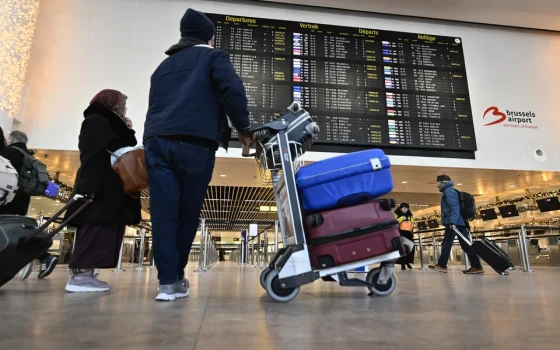
Historic Agreement on Strengthening Air Passenger Rights in the EU: Includes Financial Compensation, Easier Access to Concessions, and Maintaining Air Connectivity

- Europe and Arabs
- Tuesday , 16 June 2026 6:2 AM GMT
Brussels: Europe and the Arabs
Air passengers across the European Union will soon benefit from simpler, clearer, and stronger rights. A landmark agreement reached between the Council and the European Parliament updates EU rules on air passenger rights and airline liability. The new framework strengthens passenger protection while ensuring a fair balance with the operational realities of airlines. It also helps maintain air connectivity across the EU and ensures a level playing field for airlines. A European statement in Brussels quoted Alexis Vavidis, Minister of Transport, Communications and Works of the Republic of Cyprus, which holds the current rotating presidency of the EU, as saying, "I am proud that after 13 years of negotiations, we have reached a landmark agreement to strengthen air passenger rights in the EU. This updated framework will provide certainty, fairness, and stronger protection for millions of air passengers in Europe. The agreement strikes a fair balance for our airlines, helping to maintain the air connectivity that is vital to the EU's single market and its citizens."
Air passenger rights in the EU provide a high level of protection, particularly in cases of denied boarding, delays, or cancellations. This agreement strengthens and clarifies passenger rights, particularly regarding access to assistance and flight diversions, the right to timely information, and the right to compensation in cases of cancellation or delay.
Simplifying Claims Procedures
The new rules will make it easier for passengers to exercise their rights.
In the event of a delay that may qualify for compensation, the airline must notify passengers electronically within 96 hours of arrival. The airline must also provide passengers with information about their rights and clear instructions on how to claim compensation.
Airlines are required to acknowledge receipt of the claim immediately and then respond within 14 days, either by paying compensation or providing a clear justification for denying the claim.
Right to Compensation in Cases of Cancellation and Delay
Passengers are entitled to compensation in the following cases:
The flight arrives more than three hours late, or
The flight is canceled less than 14 days before departure. Compensation levels remain largely the same as those currently in place, meaning that starting from a three-hour delay, passengers are entitled to the following compensation:
€250 for all flights up to 1,500 kilometers,
€400 for all flights within the EU or flights between 1,500 and 3,500 kilometers,
€600 for all other flights.
Right to Assistance
The agreement outlines passengers' right to assistance during disruptions.
It stipulates that in the event of disruption, air passengers are entitled to:
Refreshments every two hours of waiting time,
A meal after three hours and every five hours thereafter (up to a maximum of three meals per day),
Internet access and two phone calls.
If an overnight stay or longer is required, passengers must be provided with free hotel accommodation, as well as free airport transfers to and from their accommodation.
If the airline fails to provide the necessary assistance, passengers have the right to make their own arrangements and claim a refund. New Rights
The agreement also includes several new rights, including a ban on denying boarding to any passenger for not being present on the arrival flight.
To ensure price transparency, airfares, including carry-on baggage allowance, are automatically displayed before any booking process begins, making it easier to compare prices between airlines.
The system also includes specific and enhanced rights for people with disabilities, such as those with limited mobility, children, unaccompanied minors, and pregnant women. These rights will be strengthened and expanded. For example, families, people with disabilities, and their companions will be able to sit together at no extra cost. No-shows will be strictly prohibited for passengers with mobility impairments, pregnant women, and unaccompanied minors.
Furthermore, passengers with mobility impairments will have the following rights:
New compensation rights in case airports fail to provide adequate assistance;
Priority access to assistance or flight diversions;
The ability to travel with their own mobility equipment and assistance dogs without needing additional insurance;
Free replacement of their mobility equipment in case of loss or damage;
The right to information and facilitated communication with airlines;
Passengers must be informed more clearly and comprehensively of their rights in the event of any disruption, and must be informed of the reason for the disruption as soon as information becomes available.
If an airline anticipates a flight delay, passengers must be notified as soon as possible, and no later than the departure time printed on the ticket. Airlines must provide at least one free and effective means of communication.
Right to flight diversion:
Passengers who choose to change their flight route must be provided with an alternative route as soon as possible after a flight cancellation or denial of boarding (unless the denial is based on valid reasons) within three hours. This includes, where appropriate, changing the route to an alternative airport, via a different route, on flights operated by another airline, or through other means of transportation.
The route change must be provided at the airline's expense and under similar transportation conditions. For example, passengers should not be forced to take multiple connecting flights if they have booked a direct connecting flight.
Passengers can also be rerouted to a higher class at no extra cost. Airlines remain responsible for compensating for delays upon arrival.
If the airline does not offer a flight rerouting service within three hours, passengers have the right to arrange their own rerouting and claim compensation of up to 400% of the original ticket price.
Further clarification for passengers and airlines regarding exceptional circumstances:
The agreement clarifies the concept of exceptional circumstances, which are events beyond the control of the airline and unrelated to its normal operations. The text includes a non-exhaustive list of such circumstances. If exceptional circumstances apply, airlines may not be obligated to pay compensation.
If the airline invokes exceptional circumstances to deny a compensation claim, it must provide passengers with a clear, substantiated, and easily understandable explanation.
Exceptional circumstances can only be invoked if they affected the flight in question, or at most one of the three preceding flights in the aircraft's operating sequence, and there is a direct causal link between the exceptional circumstance and the disruption. The burden of proof lies with the airline, including demonstrating that all reasonable measures were taken to avoid disruption.
Scope of application
These rules apply to passengers:
Passengers within the EU, on flights operated by EU or non-EU airlines;
Arriving in the EU from a non-EU country on EU airlines; and
Departing from the EU to a non-EU country on EU or non-EU airlines.
Under the agreement, the Commission will assess the possibility of revising the scope of the regulation within three years, and potentially extending it to airlines from third countries. To better inform passengers about the airlines covered by the EU Air Passenger Rights rules, an optional EU Air Passenger Rights sticker will be introduced and displayed during the booking process. The Commission will develop this sticker.
Next steps
Today’s agreement still needs to be formally adopted by both the European Parliament and the Council, following linguistic and legal review. Air passengers in the European Union have benefited from protection in cases of denied boarding, delays, and cancellations since the EU Air Passenger Rights Rules came into effect in 2004.
Over time, legal ambiguities and evolving case law have led to uncertainty for both passengers and airlines regarding the interpretation and application of these rules. In response, the European Commission proposed a revision of the framework in 2013.






No Comments Found