

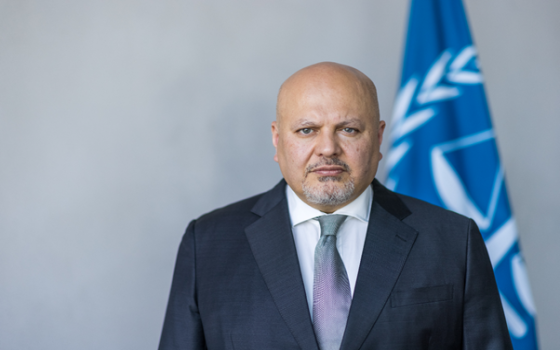
The Man Who Intended to Arrest Netanyahu.. ICC Member States Remove Prosecutor Karim Khan

- Europe and Arabs
- Saturday , 25 July 2026 11:13 AM GMT
The Hague – New York: Europe and the Arabs
Member states of the International Criminal Court (ICC) voted to remove the court's chief prosecutor, Karim Khan, following disciplinary proceedings related to widely publicized allegations of sexual misconduct. The decision was made during an emergency session held on Friday at the United Nations headquarters in New York.
The vote to remove Khan was a simple majority, with all 125 member states of the Assembly of States Parties participating.
What is the International Criminal Court?
The International Criminal Court (ICC) was established by the Rome Statute, a founding document signed by the States Parties. In it, the States Parties pledged to prevent crimes and bring those responsible to justice.
The ICC prosecutes individuals for genocide, war crimes, crimes against humanity, and aggression—the most serious crimes of international concern. The Court is based in The Hague, Netherlands.
The Court is a court of last resort. National courts investigate and prosecute crimes committed within a country. The ICC only intervenes if a state is unable or unwilling to investigate and prosecute crimes.
The Court has neither a police force nor an army of its own. It relies on states to arrest and surrender suspects. Arrest warrants remain valid for life unless the judges of the Court decide otherwise. (See: Understanding the International Criminal Court)
Khan had been elected in 2021 to a nine-year term as the court's chief prosecutor.
The president of the Assembly of States Parties stated, "The Assembly, by a majority of 82 States Parties, decided that Prosecutor Karim Khan had committed serious misconduct and a grave breach of his duties, and decided to remove him from his post." He also called for respect for the dignity and privacy of all those involved.
The Assembly of States Parties is scheduled to begin the process of electing a new prosecutor for the court soon. The Court's Achievements and Limits of its Jurisdiction
Since its establishment in 2002 under the Rome Statute, the International Criminal Court (ICC) has set international standards for prosecuting the most serious crimes. To date, it has issued seven convictions and is currently considering 34 cases.
The Court does not have the power to enforce arrest warrants itself, relying instead on the cooperation of states, particularly its 125 member states, according to the UN Daily News.
Not all states have joined the Rome Statute. Israel and the United States, for example, have not ratified the treaty, despite signing it in 2000.
In 2025, the United States imposed sanctions on nine ICC officials, including judges, the Prosecutor, and his two deputies, in connection with investigations into alleged war crimes committed by Israel and the United States.
Timeline of Misconduct Allegations
November 2024: The ICC requested the United Nations Office of Internal Oversight Services (OIOS) to conduct an external investigation.
May 2025: Karim Khan took a leave of absence pending the outcome of the investigation, while the two Deputy Prosecutors assumed leadership of the Office of the Prosecutor.
March 2026: The Assembly of States Parties received the findings of a panel of judicial experts.
June 2026: The Bureau of the Assembly of States Parties based its assessment on the report of the Office of Internal Oversight Services, supporting evidence, the opinion of judicial experts, and the written submissions.
June 2026: By a qualified majority, the Bureau of the Assembly decided to refer the disciplinary proceedings to the Assembly of States Parties, to immediately suspend the Prosecutor's duties pending a final decision, and to convene an extraordinary session.
According to media reports, the decision by the member states of the International Criminal Court to remove Prosecutor Karim Khan, following allegations of sexual misconduct which he denies, has raised questions about the fate of the cases he oversaw, most notably the arrest warrant issued against Israeli Prime Minister Benjamin Netanyahu.
Khan was the figure who, in May 2024, led the most sensitive case in the Court's history in recent years, after requesting arrest warrants for Netanyahu, former Israeli Defense Minister Yoav Gallant, and three Hamas leaders, on charges of war crimes and crimes against humanity. In November 2024, the Pre-Trial Chamber of the Court approved the issuance of arrest warrants for Netanyahu and Gallant.
Unprecedented Political Pressure
Since announcing his request for the arrest warrants, Khan has faced a campaign of criticism and political pressure from Israel and the United States, both of which reject the Court's jurisdiction in this case. Washington has also imposed punitive measures on Court officials due to investigations related to Israel.
In contrast, Khan's supporters believe that targeting him stems from his confrontations with powerful governments over the Ukraine and Palestine cases, while his opponents maintain that his dismissal is based on the findings of an internal investigation into allegations of personal misconduct, allegations he continues to deny, describing his dismissal as illegal.
Will Netanyahu's arrest warrant be affected?
According to the Rome Statute of the International Criminal Court, the dismissal of the Prosecutor does not invalidate or suspend previously issued arrest warrants, as their issuance is a decision of the Court's judges, not the Prosecutor alone. Thus, the arrest warrants against Netanyahu and Gallant remain in effect unless the relevant judicial chamber decides to cancel or amend them, which has not yet happened. The cases will be transferred to the next prosecutor or to the officials in charge of the prosecution office until a permanent successor to Khan is elected.
Observers believe that Khan's dismissal opens a new chapter for the International Criminal Court, which is simultaneously facing increasing legal and political challenges amidst ongoing major international conflicts, most notably the war in Gaza and the war in Ukraine, and amidst ongoing debate about the court's independence and its ability to enforce its decisions in the face of international pressure.
On Friday, Axios reported that members of the International Criminal Court voted to dismiss Prosecutor Karim Khan, with 82 out of 110 members supporting his removal.
According to Axios, Khan was the one who issued the arrest warrants against Israeli Prime Minister Benjamin Netanyahu and former Israeli Defense Minister Yoav Gallant on charges of war crimes in the Gaza Strip. The website quoted an Israeli official as saying that the Israeli foreign minister and Israeli embassies worldwide worked to garner as many votes as possible to support the removal of Attorney General Karim Khan.
Khan, 56, denies any wrongdoing, and his lawyers described the proceedings leading to the vote as illegal, procedurally unfair, and lacking any evidence, according to Reuters.
Khan had issued an arrest warrant for Israeli Prime Minister Netanyahu and other Israeli military and security leaders on charges of war crimes in Gaza.



No Comments Found