

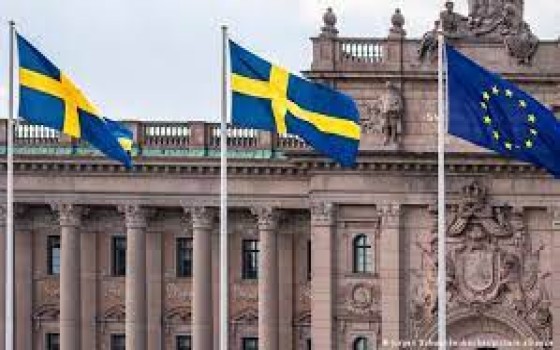
Swedish Elections: Far-Right Declines for the First Time Since 2010; Left-Wing Alliance Holds Slight Lead

- Europe and Arabs
- Monday , 14 September 2026 6:49 AM GMT
Stockholm – The Hague: Europe and the Arabs
With 94% of the votes counted, the left-wing alliance holds a narrow lead over the right-wing parties. Meanwhile, the far-right Sweden Democrats party is seeing a decline in support for the first time since 2010.
Shortly after 5:00 AM, left-wing parties had secured 49.5% of the vote—enough for 176 seats—while the right-wing alliance garnered 49.1%, or 173 seats. The Swedish parliament comprises 349 seats, and forming a government requires a majority of at least 175 seats.
From the earliest opinion polls, it appeared that Social Democrat Magdalena Andersson stood a strong chance of once again becoming Sweden's Prime Minister. Although her party lost some votes, it remained the largest party by a clear margin, securing over 28% of the vote. According to the same polling data, the four left-wing parties combined won more than 51% of the vote. As the night progressed, the left-wing bloc's lead became increasingly apparent. In her victory speech, Andersson struck a cautious tone given the tight race, stating: "We, the Social Democrats, will always be ready to shoulder our responsibilities. At this moment, we are in the lead. If the situation holds, Sweden will have a new government." Just hours before the preliminary results were announced, Noureddine Amrani—a Hague-based expert and researcher on European affairs—stated that the spread of right-wing extremism to Sweden was no coincidence. The continent is grappling with economic and social issues that have impacted both domestic and foreign policy, driven by successive shocks to European economies. These include the US-Israeli conflict with Iran—which caused oil prices to skyrocket following the closure of the Strait of Hormuz—and the Russia-Ukraine war, which significantly drove up the costs of energy and essential goods while eroding citizens' purchasing power. People have grown desperate and frustrated by the persistent struggle to make ends meet amidst rising living costs and the failure of EU governments to alleviate a situation that has hit low-income earners and the middle class particularly hard. To capitalize on public anger, far-right parties are coordinating across the continent to scapegoat the migrants "flooding" into Europe—a region that once championed slogans of social solidarity and multiculturalism. Yet, current reality confirms that the democracy so often touted is a "malleable" one: it expands to accommodate the bloc's own interests but contracts when it comes to the interests of migrants. Here is an analysis of the elections held in Sweden on Sunday. The outcome hinges on a delicate political calculus; the left-wing opposition holds a narrow lead, but the right is racing to close the gap. If this momentum persists, the far-right Sweden Democrats party could find itself with an opportunity to participate in government. A week after the political earthquake in the German state of Saxony-Anhalt—where the far-right "Alternative for Germany" (AfD) party achieved a landslide election victory—Sweden could become the stage for the far-right's next resounding triumph in Europe this Sunday. The Sweden Democrats (SD)—a party originally founded by neo-Nazis—stand on the verge of joining a governing coalition for the first time. Current Swedish Prime Minister Ulf Kristersson has pledged to include the Sweden Democrats in his right-wing coalition should they secure a majority on Sunday. Kristersson, leader of the liberal-conservative Moderate Party, recently told Reuters: "We agreed to campaign with the aim of forming a joint majority government, and that I would lead that government." For the past four years, Kristersson has led a minority government that relied on support from the Sweden Democrats. These elections will reveal whether Sweden is ready for the next step of formally bringing a far-right party into the seat of power; the outcome remains uncertain, however, as the left-wing opposition holds a narrow lead in the polls, with the Social Democrats—led by opposition leader Magdalena Andersson—positioned as the largest party. The picture was vastly different just a few months ago, when left-wing opposition parties held a comfortable lead of over 10 percentage points; yet, over the summer, a scenario unfolded reminiscent of the ancient Greek fable of the tortoise and the hare. The Social Democrats may have felt overconfident about their victory—like the hare that decided to take a nap, only to open its eyes and see the tortoise crossing the finish line. Of course, the outcome in Sweden has not yet been decided. One explanation for the Right’s surge to close the gap is the voter recognition it has gained for tackling gang crime and reforming immigration policy with an iron fist. Sweden’s asylum policy—once known for its extreme generosity—has in recent years been replaced by a restrictive approach similar to that of the Netherlands. Consequently, the number of asylum applications has dropped to its lowest level in forty years. Coupled with a record number of deportations, this resulted last year—for the first time in half a century—in a net outflow of people from Sweden. Swedish politician Ulf Kristersson has stated that he would include the Sweden Democrats party in his right-wing coalition if it secures a majority on Sunday. Kristersson, leader of the liberal-conservative Moderate Party, recently told Reuters: "We agreed to campaign with the aim of forming a joint majority government, and that I would lead that government." The Social Democrats may have felt overconfident about their victory—like the hare that decided to take a nap, only to open its eyes and see the tortoise crossing the finish line. Of course, the outcome in Sweden has not yet been decided. One explanation for the right-wing’s push to close the gap is the voter recognition it has gained for tackling gang crime and reforming immigration policy with an iron fist. Sweden’s asylum policy—once known for its extreme generosity—has in recent years been replaced by a restrictive approach similar to that of the Netherlands. Consequently, the number of asylum applications has dropped to a forty-year low. Coupled with a record number of deportations, this resulted—for the first time in half a century—in a net outflow of people from Sweden last year. Swedish politician Ulf Kristersson has stated that he would include the Sweden Democrats party in his right-wing coalition should they secure a majority on Sunday. Kristersson, leader of the liberal-conservative Moderate Party, recently told Reuters: "We agreed to campaign with the aim of forming a joint majority government, and that I would lead that government." The Social Democrats may have been overconfident in their victory—much like the hare that decided to take a nap, only to open its eyes and see the tortoise crossing the finish line. Yet, the outcome in Sweden is, of course, not yet settled. All the measures through which the government achieved this result were on the Sweden Democrats' political wish list—and some were highly controversial; for instance, permanent residence permits for asylum seekers have been almost entirely eliminated since last year. Furthermore, young adults who grew up in Sweden have been deported because—due to protracted asylum procedures—they failed to secure permanent residency status before their eighteenth birthdays. Intense protests led to a scaling back of the deportation of teenagers from Sweden. However, as of July 1st, youths as young as 15 in Sweden can face imprisonment for committing serious crimes. This law, drafted by the Sweden Democrats, was enthusiastically embraced by Justice Minister Gunnar Strömmer of the Moderate Party. The popularity of Strömmer—one of the current government's leading politicians—illustrates a broader shift in public support for policies that the majority of the population would have rejected a decade ago as overly harsh. Yet, beyond promises regarding healthcare waiting lists, education improvements, and financial compensation for retirees, the campaign lacks a clear, substantive narrative. Furthermore, Andersson remains vague about his preferred form of government in the event of a victory: a minority coalition supported by other parties on the left, or a coalition with the Green Party? Then there is a new option: cooperation with the Christian Democrats. While they are part of the current government, they have distinguished their campaign by opposing the drift toward the far right. Key campaign issues in Sweden are primarily domestic, as the two rival political blocs agree on the broad outlines of major foreign policy matters. From the Sweden Democrats to the Green Party, there is support for the recent NATO accession and for military aid to Ukraine—a stance shared by 70 percent of the Swedish public, according to recent research. Yet the question remains: what face will the Sweden Democrats show if they actually secure seats in the Swedish parliament in Stockholm? In recent years, party leader Jimmie Åkesson has managed to gradually dismantle the *cordon sanitaire* surrounding the party, aided by the prevailing *zeitgeist*. At the same time, the party leadership has sidelined radical members and formally distanced itself from its neo-Nazi roots. The Social Democrats' initial lead stemmed primarily from the inflation Sweden has experienced in recent years—a factor for which incumbent governments are almost inevitably punished. Political scientist Anders Sannerstedt of Lund University observes: "What appears to be weakening the Social Democrats now is that their campaign lacks clear substantive weight." The party—traditionally the dominant force in Sweden—seems to be relying chiefly on the credible image of its lead candidate, former Finance Minister Magdalena Andersson. According to Sannerstedt, she is indeed "someone you can trust to lead the country without wrecking it."






No Comments Found