
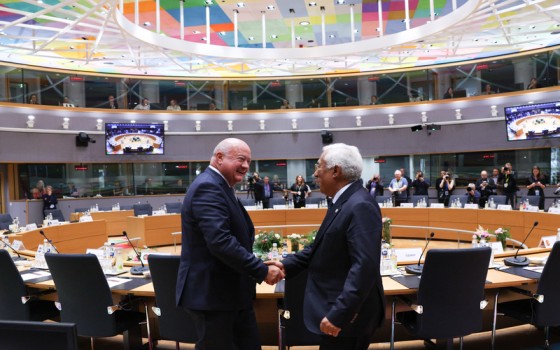
The Brussels Summit defined the European Union’s position on developments in the Middle East, specifically regarding Yemen, Iran, Syria, Gaza, and Lebanon.

- Europe and Arabs
- Saturday , 17 October 2026 6:1 AM GMT
Brussels: Europe and the Arabs
In the concluding statement of the European Union leaders' summit held in Brussels on Thursday and Friday, the European Council expressed its grave concern regarding the current security situation and the ongoing military escalation in the region. The European Union will continue to emphasize the necessity of respecting international law and—in close coordination with regional partners—will engage in diplomatic efforts aimed at de-escalating tensions and ensuring peace and stability.
The European Council called on all parties to cease destabilizing activities and reaffirmed the paramount importance of ensuring freedom of navigation and maritime security, in accordance with international law and the United Nations Convention on the Law of the Sea (UNCLOS). The current situation risks causing long-term disruptions to global supply chains—particularly concerning energy, fertilizers, and food—which would have severely damaging repercussions for economies and the most vulnerable populations worldwide.
Iran
The European Council reiterates its strong condemnation of attacks launched by Iran against countries in the region and expresses its solidarity with the affected nations. It further calls upon Iran and its proxies to refrain from carrying out such attacks or any other destabilizing activities, and to respect the sovereignty and territorial integrity of the countries in the region.
The European Council also strongly condemns any actions that threaten navigation or prevent commercial vessels from entering or exiting the Strait of Hormuz. Any arrangements concerning the Strait of Hormuz must be consistent with international law and the United Nations Convention on the Law of the Sea, and must not, in any way, restrict freedom of navigation or alter the existing management regime.
The European Council reaffirms that Iran must, under no circumstances, be permitted to possess a nuclear weapon. It urges Iran to comply with its legally binding obligations regarding nuclear safeguards under the Treaty on the Non-Proliferation of Nuclear Weapons (NPT) and to resume full cooperation with the International Atomic Energy Agency (IAEA).
The European Council strongly condemns the ongoing acts of violence and the brutal repression perpetrated by the Iranian regime against its own people, including widespread executions. It further calls for respect for the universal human rights and fundamental freedoms of the Iranian people, including their right to determine their own future. EUCO 14/26
Yemen
The European Council strongly condemns the continued military escalation by the Houthis in Yemen and their attacks against the Kingdom of Saudi Arabia—particularly those targeting civilians and civilian infrastructure—and expresses its solidarity with the legitimate government of Yemen and the Kingdom of Saudi Arabia. The Council emphasizes the need to prevent any further deterioration of the already dire humanitarian situation and calls for increased international assistance in this regard.
The European Council calls upon the Houthis to immediately cease all military operations and all attacks against civilian shipping, which threaten maritime security in the Red Sea and the Strait of Bab al-Mandab. The European Council points to the role of the EU’s defensive maritime operation (EUNAVFOR ASPIDES), highlights its potential to contribute to regional stability—including through coordination with existing initiatives—and calls for its strengthening in line with its mandate. In this context, the Council underscores the importance of complementarity among international initiatives aimed at ensuring freedom of navigation.
Gaza/West Bank
Recalling its previous conclusions, the European Council reaffirms the EU’s commitment to a comprehensive, just, and lasting peace, based on a two-state solution and in accordance with relevant UN Security Council resolutions, whereby two democratic states—Israel and Palestine—live side by side in peace and within secure and recognized borders. The Council also strongly condemns actions, policies, and rhetoric that undermine the viability of the two-state solution. The EU will continue to support the "Global Alliance for the Implementation of the Two-State Solution." EUCO 14/26
The European Council reiterates its grave concern regarding the deteriorating situation in the Gaza Strip and the West Bank, including the ongoing and devastating humanitarian crisis in Gaza, which threatens to worsen as winter approaches. The Council urges Israel to allow immediate and unimpeded humanitarian access, to ensure the sustained and large-scale distribution of aid throughout the Gaza Strip—including via the Cypriot maritime corridor as a supplement to land routes—to permit the entry of international media, and to reopen the Gaza Strip’s border crossings as well as the medical corridor connecting the Gaza Strip to the West Bank. Israel must also enable the United Nations, its agencies, and humanitarian organizations to operate independently and impartially in order to save lives and alleviate suffering, and it must comply with all its obligations under international law, including international humanitarian law. The protection of civilians must be guaranteed at all times.
The European Council expresses its concern regarding the lack of progress in implementing a ceasefire and all other provisions set forth in United Nations Security Council Resolution 2803. The Council calls upon all actors to implement these provisions fully and without delay, in line with relevant Security Council resolutions and international political and legal principles—specifically regarding the permanent disarmament of Hamas and other non-state armed groups, the complete withdrawal of Israeli forces from the Gaza Strip, and the transition toward a civilian administration in the Strip. Hamas should have no role in the future governance of the Gaza Strip. The European Union will continue to contribute to the implementation of UN Security Council Resolution 2803, as well as to the reconstruction and development of the Gaza Strip, in accordance with international law. In this context, the European Council welcomes the renewal of the mandates of both the EU Border Assistance Mission at the Rafah Crossing Point (EU BAM Rafah) and the EU Police Mission for the Palestinian Territories (EUPOL COPPS). The European Council also welcomes the launch of the "Team Gaza Initiative" and calls for close coordination with the Palestinian Authority, the United Nations, and international partners regarding early recovery and the reconstruction of the Gaza Strip.
The European Council expresses its regret over the announcement of the postponement of Palestinian elections and calls on the Palestinian Authority to hold legislative and presidential elections as soon as possible, by early 2027. The European Union will continue to support the Palestinian Authority, including its reform agenda. Furthermore, the European Council reiterates its call on Israel to urgently release all withheld clearance revenues and to extend the correspondent banking services between Israeli and Palestinian banks; both measures are essential to ensure the proper functioning of the Palestinian Authority and the delivery of basic services to the population.
The European Council reaffirms its condemnation of the unilateral actions taken by Israel to expand its presence in the West Bank, including East Jerusalem—actions that were deemed unlawful in the advisory opinion issued by the International Court of Justice on July 19, 2024. The Council strongly condemns the continued and escalating settler violence against Palestinian civilians, including Christian communities and other minorities, and demands accountability for those responsible. It reiterates its call for the preservation of and respect for the *status quo* regarding the holy sites in Jerusalem. The European Council urges Israel to immediately reverse the expansion of settlements—which are illegal under international law—including the withdrawal of construction tenders in the "E1" area. The Council reaffirms that companies should not bid for construction contracts in the "E1" area or other settlement projects, emphasizing the legal, economic, and reputational consequences that companies and financial institutions involved in settlement construction may face, including the risk of complicity in serious violations of international law.
The European Council underscores the importance of maintaining a diplomatic presence in the Occupied Palestinian Territory, including the presence of EU Member States, in order to engage with the Palestinian Authority and thereby contribute to the realization of a two-state solution.
Lebanon
The European Council welcomes the framework agreement signed by Lebanon and Israel in June 2026. It urges all actors to fully adhere to the terms of the agreement and to engage constructively in further talks aimed at a permanent cessation of hostilities, in full compliance with international law, including international humanitarian law.
The European Council calls on all parties to fully implement UN Security Council Resolution 1701, which must serve as the basis for any lasting solution. It also reiterates its call for the complete disarmament of Hezbollah. The European Council calls upon Israel to respect the sovereignty and territorial integrity of Lebanon, and to withdraw its forces from Lebanon, in line with United Nations Security Council Resolution 1701. The European Council further emphasizes the critical importance of maintaining an international presence in Lebanon beyond the mandate of the United Nations Interim Force in Lebanon (UNIFIL).
The European Union will continue to support the Lebanese people, including in the long term, in close coordination with international partners. The European Council reaffirms the European Union’s full support for the Lebanese government’s efforts to strengthen the Lebanese Armed Forces, with the aim of extending their control over the entire Lebanese territory and consolidating the state’s monopoly on the possession of arms. The European Council also welcomes the establishment of a European Union support mission in Lebanon.
Syria
The European Council reiterates its support for a peaceful and inclusive, Syrian-led transition process, and takes note in this regard of recent developments, including the inaugural session of the People’s Assembly. The European Union remains committed to deepening its partnership with Syria for the benefit of the Syrian people. The Council
notes that achieving comprehensive transitional justice is essential for the path toward reconciliation. It further urges
all parties—whether internal or external—to fully respect the unity, independence, sovereignty, and territorial integrity of Syria, in accordance with international law, including the United Nations Convention on the Law of the Sea (UNCLOS).




No Comments Found