


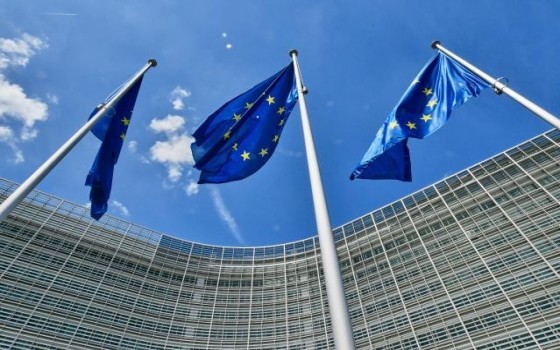
Europe's energy crisis worsens hours after Trump's speech... Reduced consumption to confront a serious crisis... Search for cheaper oil in neighboring countries and airlines consider canceling flights or raising prices.

- Europe and Arabs
- Thursday , 2 April 2026 7:38 AM GMT
Brussels: Europe and the Arabs
Europe is currently facing a serious energy crisis due to the repercussions of the ongoing war in the Middle East and the closure of the Strait of Hormuz. This has prompted many officials in the European Commission and member state governments to describe the situation as a serious crisis and call for reduced consumption in light of soaring prices. Some countries, such as Slovakia, have even decided to increase fuel prices for drivers coming from neighboring countries to counter what has been termed "energy tourism." Airlines have also announced their intention to raise prices or cancel flights starting next May to cope with this crisis. US President Donald Trump dashed regional and international hopes that were pinned on a ceasefire announcement, declaring the continuation of "Operation Epic Wrath" and confirming the extension of the war against Iran for several more weeks.
From the heart of the White House, Trump delivered a fiery speech dominated by threatening language and military posturing, categorically and explicitly denying all leaks about a possible de-escalation. The US president threatened Tehran with what he described as "very severe" strikes, explaining that the war would escalate over a period of two to three weeks.
The speech, which held the world in suspense for a full day, attempted to answer the question: When will the war end? Although Trump tried to reassure both domestic and international audiences that the end was "very near" and would not exceed a few weeks, he refrained from declaring a final victory, preferring to keep the war machine on high alert. According to the European news network Euronews in Brussels, published on Thursday,
In reviewing the results of the operations, Trump focused on what he considered "swift, decisive, and overwhelming victories," asserting that the major strategic objectives of the United States were in their final stages and nearing completion. He also boasted about curtailing Iranian military power, emphasizing the destruction of a significant portion of its conventional capabilities to such an extent that, in his words, it "no longer poses a real threat" to American interests.
The American president did not stop at showcasing military power, but went further by declaring that "regime change" had become a reality, while continuing his threats of launching devastating missile strikes.
Trump focused particularly on the Iranian nuclear program, revealing that all facilities and uranium storage sites are now under close satellite surveillance around the clock. He also threatened a decisive and uncompromising response to any suspicious Iranian activity in this regard, emphasizing that any attempt to activate this program would be met with overwhelming and devastating force.
Dual Messages
In another part of his speech, he adopted President Trump employed a "dual-message" approach, seeking to reassure Washington's regional allies by explicitly thanking Israel, Saudi Arabia, Qatar, the UAE, Kuwait, and Bahrain. He reiterated his country's firm commitment to protecting these nations and providing them with the necessary security against any potential threats.
Conversely, Trump made assertive statements regarding global energy security, attempting to deprive Tehran of one of its most significant bargaining chips. He sharply downplayed the strategic importance of the Strait of Hormuz to the United States, emphasizing that his country "did not need it in the past and will not need it in the future."
Trump's tone presented energy-dependent nations with a difficult choice: either rely on the United States as an alternative energy source or bear the consequences and responsibility of securing maritime routes using their own capabilities. Trump minimized the complexities of the maritime security landscape, describing control of the straits as "easy," and indicating Washington's readiness to provide technical and logistical support to whoever decides to undertake this task.
On the alliance level, the complete absence of any mention of NATO in the speech was striking and raised questions, especially given its timing. In the context of his previous statements threatening to withdraw from the alliance, this disregard deepened the rift with European allies, especially after he had previously described the alliance as a "paper tiger."
The War's Domestic Cost
The dire economic situation was not absent from Trump's speech, as he attempted to mitigate public anger over the war's impact on the average American's wallet. The president acknowledged the increasing pressure resulting from rising fuel prices, but sought to reassure the public by describing the increase as "transient and temporary."
This admission comes at a time when the average price of a gallon of gasoline in the United States has surpassed $4, a peak not seen in the markets since 2022. Regarding the military aspect, what Trump omitted was noteworthy. He deliberately ignored the scenario of a large-scale ground confrontation, despite growing international concerns about it, in a clear attempt to calm American public opinion's fears of being drawn into a protracted war of attrition.
Although he limited operations to swift air and missile strikes, the American military buildup and the thousands of troops deployed in the region remain a significant factor. The possibilities remain, leaving the door ajar for any future expansion of the scope of field operations.
Tehran responded directly to President Trump's announcement of the weakening of its military capabilities, with Iranian state television broadcasting messages challenging American assertions and affirming that its missiles "can reach the port of Haifa."
Turning to the repercussions in European countries, Slovakia has taken measures to combat fuel tourism and is imposing additional charges on foreigners starting immediately.
This drastic emergency measure is generating widespread controversy within the European Union, as drivers with foreign license plates pay higher fuel prices in Slovakia than Slovak citizens themselves. The government hopes to curb fuel tourism in this way.
Asian stock markets fell and oil prices rose again after Trump's speech.
Asian stock markets declined and oil prices rose again after Trump stated that Iran would be hit "very hard" in the coming weeks.
Japan's Nikkei index in Tokyo fell 2.25% around 6:00 AM Belgian time, while South Korea's Kospi index dropped 4%. Sydney (-1%), Taipei (-1.1%), and Hong Kong (-1.1%) also recorded losses. Oil prices surged again after stabilizing somewhat since Tuesday following the US president's comments about a possible withdrawal from the war within "two to three weeks." The price of Brent crude, the international benchmark, jumped more than 5% to $106 a barrel. West Texas Intermediate (WTI) crude, the US benchmark, also rose more than 4% to $104.50 a barrel.
The Belgian government warned that energy supplies are at risk and called for a "recalibration of our behavior." In parliament, Foreign Minister Maxime Priveaux, from the "Committed" party, drew attention to the security of supply. Regarding price volatility, he said, the bigger picture must be considered. He then pointed to a "significant risk to supplies in the coming months." For example, there is the issue of energy coming from Qatar, where problems are expected, adding to the existing problem of nuclear reactors currently offline for maintenance. This relates to maintenance work on the Doel 4 and Tihang 3 lines as part of a project to extend their operational life by ten years. The work will continue from today, April 1, until November 1. According to Elia, the operator of the high-voltage network, there is no risk to the security of supply.
Prevot also pointed out, among other things, the importance of changing behaviors to reduce fuel and natural gas consumption, noting that some countries are already calling for a reduction in oil and gas consumption.
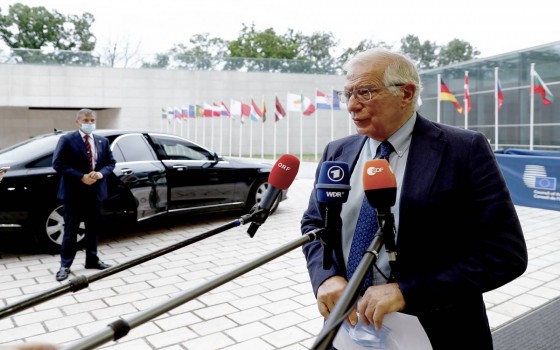
The European Commission has recommended that member states take measures to reduce oil use. "The more we do to conserve oil, especially diesel and jet fuel, the better for us," said European Energy Commissioner Dan Jorgensen on Tuesday, following consultations with European energy ministers. Jorgensen and the ministers discussed the implications of the war in the Middle East via videoconference on Tuesday. Although there is no immediate shortage of oil or gas, the European Commissioner already sees "tightening markets for some products, such as diesel and jet fuel" and "increasing restrictions on the global gas market."
Therefore, Jørgensen recommended that ministers take advantage of the International Energy Agency's ten-point plan, which calls for remote working, reducing highway speed limits by at least 10 kilometers per hour, car sharing, and promoting public transport, among other measures.
According to the European Commissioner, the repercussions of the war in the Middle East on energy markets will not be short-lived, even if the fighting were to stop tomorrow. Vast swathes of the region's energy infrastructure have been destroyed, he emphasized. "We will not return to normal in the near future." Ryanair warns of price hikes and flight cancellations. Ryanair is not ruling out mass cancellations of its flights this summer due to fuel shortages caused by the ongoing war in the Middle East. Ticket prices could rise sharply as a result of the significantly increased cost of kerosene. Ryanair CEO Michael O'Leary warned of this at a press conference.
Lufthansa is considering grounding dozens of aircraft due to soaring kerosene prices.
The German airline group Lufthansa is exploring various scenarios to address the surge in kerosene prices caused by the war in the Middle East. According to the business daily Handelsblatt, employees have been informed of this. The group, which also owns Brussels Airlines, confirmed this information.
According to Handelsblatt, CEO Carsten Spohr, among other things, requested a calculation of the impact of grounding 20 or 10 aircraft.
In Belgium, the consumer organization Testancup advised families against signing new fixed-rate energy contracts at this time. This advice was issued on Wednesday after analyzing the energy tariff schedules available for April from energy companies. The newspaper HetLaatste Nieuws reported, "The war in the Middle East has caused a significant increase in crude oil and natural gas prices. This is reflected in the new fixed prices set by energy companies: gas contracts, in particular, have become much more expensive this month. In Flanders, the organization Testankop expects natural gas prices to rise by at least a third, and possibly as much as 71%, compared to March. The average price has increased from 5.05 to 7.83 cents per kilowatt-hour, a rise of 55%. The organization states, "This equates to an increase of €473 based on an average annual consumption of 17,000 kilowatt-hours." Electricity prices have also risen by an average of 28%, reaching 17.81 cents per kilowatt-hour compared to 13.97 cents, with Testankop noting increases ranging from 0% to 37%. The organization adds that this means, on an annual basis, an additional €135 for the average household consuming 3,500 kilowatt-hours. kilowatt-hour.




No Comments Found