
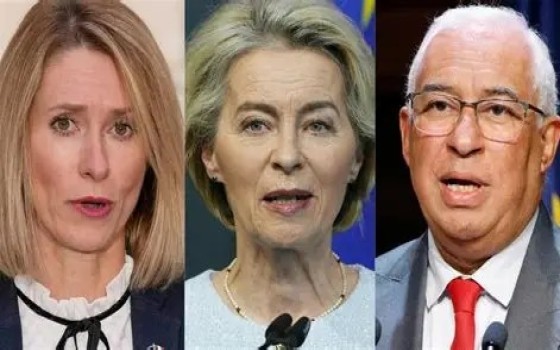
The President of the European Union begins a Gulf tour in the UAE to discuss developments in the region, while the President of the European Commission highlights the repercussions on the European economy, particularly energy resources.

- Europe and Arabs
- Tuesday , 14 April 2026 6:36 AM GMT
Brussels: Europe and the Arabs
Hours after the European Commission President's statement in Brussels regarding the repercussions of the Middle East conflict on the European economy, European Council President António Costa began his tour of the Gulf region to meet with the leaders of the United Arab Emirates, Saudi Arabia, and Qatar from April 14-15. They will discuss the latest developments in Iran and the wider region, and exchange views on ways to ensure sustainable regional and global security. President Costa will reiterate the European Union's messages of solidarity with the Gulf states and highlight the EU's commitment to contributing to de-escalation and supporting diplomatic efforts. A European statement issued in Brussels quoted Costa as saying, "Our priority and focus is on working with our partners in the Gulf to protect regional stability, safeguard civilians, and protect our interests. A lasting peace can only be achieved through negotiations and diplomacy, led primarily by the leaders of the region." According to the visit's program, European Council President Antonio Costa will meet today, Tuesday, with the President of the United Arab Emirates, Sheikh Mohammed bin Zayed Al Nahyan, in Abu Dhabi, and with the Crown Prince and Prime Minister of Saudi Arabia, Sheikh Mohammed bin Salman, in Jeddah. On April 15, President Costa will meet with the Emir of Qatar, Sheikh Tamim bin Hamad Al Thani, in Doha. Demonstrating the ongoing consultation and coordination between the two sides, EU High Representative for Foreign Affairs and Security Policy, Kaja Kallas, conducted a Gulf tour less than a week ago and held talks with leaders in the region. Regarding the latest developments, European Commission President Ursula von der Leyen announced on Monday afternoon in Brussels, following a European meeting, "We held a preliminary discussion, which focused primarily on the economic impact of the crisis in the Middle East on the European Union." As we all know, the Middle East has been engulfed in war for 44 days. The past six weeks have reminded us that peace is not a given. In recent days, a truce seemed within reach, with a ceasefire being declared, as you all witnessed. Let me thank Pakistan for its crucial role in bringing us to this point. But we also know that negotiations have now stalled, and we must wait and see how things unfold. Any agreement must address the concerns raised by Iran’s nuclear and ballistic missile programs, and its actions that disrupt navigation through the Strait of Hormuz. The continued closure of the Strait of Hormuz is causing immense damage, and restoring freedom of navigation through it is of paramount importance to us. We are also concerned that the continued attacks on Lebanon threaten to undermine the entire process. We are mobilizing ReliefEU stockpiles to provide immediate assistance to the Lebanese people, but no amount of aid can replace a lasting peace. One of the most important lessons of the past few weeks is that security is indivisible. Stability cannot be achieved in the Middle East or the Gulf while Lebanon is ablaze. We therefore call on all parties to respect Lebanon's sovereignty and implement a complete ceasefire. As we monitor the current fragile ceasefire, and despite the uncertainty, I would like us to draw lessons. This is the main objective of our steering committee meeting today. This was not the first meeting in this crisis, but it certainly comes now with a fresh and renewed perspective on the situation. Let's summarize: since the start of the conflict – 44 days ago – our fossil fuel import bill has increased by more than €22 billion. 44 days, €22 billion – with virtually no additional costs. This demonstrates the enormous impact of this crisis on our economy. Even if hostilities were to cease immediately, the disruption of energy supplies from the Gulf would persist for some time. So, we also discussed a series of measures that we will present to the leaders at the upcoming informal meeting of the European Energy Council in Cyprus next week. We will issue a statement on the Wednesday before the meeting begins. Today, we discussed a number of measures that we could present. Let me mention a few, starting with the most urgent ones.
First and foremost, it is crucial that we have strong coordination among member states. We have learned that unity is our strength in any crisis. We demonstrated this during the 2022 energy crisis through the European Energy Platform. Let me give you two figures: this platform helped consolidate 90 billion cubic meters of gas purchases for us in the EU. It also connected buyers with suppliers – linking 77 billion cubic meters – between buyers and suppliers. So, we are not starting from scratch in this energy sector coordination, but we can do more and improve our performance. We are also exploring EU-wide coordination for filling gas storage facilities in member states, to prevent multiple member states from entering the market simultaneously and thus avoiding competition among them. We will also coordinate the release of oil stockpiles to maximize their utilization. And we will ensure that emergency measures taken by member states do not negatively impact the single market. This is the "coordination" aspect.
Let me turn to the second element we discussed. This concerns how to address the various measures that Member States might implement to protect the most vulnerable households and sectors from rising energy prices. This is crucial, as we experienced the last energy crisis three or four years ago and learned valuable lessons. These measures must target the most vulnerable, be swift—immediate, not a year later—and be temporary—so they can be applied for a short period, but if enshrined in law, they must be phased out in a timely manner. We will discuss this with Member States and present some exemplary best practices for designing income support programs. All of this will be included in the statement we will present next week. This week, we will also consult with Member States on more flexible rules for state support—another important tool—to give Member States more leeway to provide temporary state support in the most affected sectors. My aim is to have this temporary state support framework adopted this month, so that we have the new temporary state support framework in place by April. This is part of the "support measures."
The third element is how to reduce demand.* Because the cheapest energy is, of course, the energy we don't use. We must reduce demand while fully respecting consumers' freedom of choice. We are studying energy efficiency. These measures include factors such as building renovations or upgrading equipment in industrial processes. These measures, along with others, will be the focus of our presentation next week to the leaders. That's regarding the "immediate measures."
At the same time, we also need further structural measures to reduce energy prices and ease the burden on citizens and businesses. We already had constructive discussions at the last European Council on the four components of the energy bill. The largest part, of course, is the energy source itself. This is followed by network charges, taxes, and fees. The smallest part is the Emissions Trading System (ETS). We discussed this at the last European Council, and we are currently working on implementing some of what we discussed, as well as designing new elements. Regarding ETS costs—which, I repeat, represent the smallest part of the energy bill—we have already proposed changes to the market stabilization reserve. We will stop eliminating allowances and strengthen the reserve's capacity. In doing so, we will enhance the stability and predictability of ETS prices without losing the important price signal. In addition, we will soon be consulting with Member States on updated Emissions Trading System (ETS) standards, taking full advantage of the flexibility afforded by the legal text. As announced, we are on track to present the full ETS review in July.
There are two other cost components: electricity taxes and network charges. Work is well underway to prepare the legislative proposals we will submit. Today’s discussion confirmed that we will present these proposals in May. Finally, we discussed the largest component of the energy bill: the energy source itself. Let me remind you and broaden the picture slightly: the Strait of Hormuz is effectively closed, and citizens are immediately feeling the impact at gas stations, in supermarkets, and on their household bills. What we are witnessing in the Middle East is not a distant crisis, but in an interconnected world, the effects are direct and immediate. This is the second fossil fuel crisis in just a few years. One thing all these events make clear: we are paying a heavy price for our over-reliance on fossil fuels. The harsh reality for our continent is that fossil fuels will remain the most expensive option for years to come.
However, Europe also possesses valuable resources: locally generated electricity from renewable and nuclear energy sources. Therefore, our strategy to reduce carbon emissions has not only gained momentum in recent years but is becoming increasingly important. Our objective is clear: we need to expand our local, affordable, and reliable energy supply. This includes a wide range of renewable energy sources, as well as nuclear power, of course, because it provides us with independence, predictability, and energy security. The only way to permanently break free from fossil fuel dependence is to modernize by converting electricity generation to renewable and nuclear energy sources and electrifying the economy as quickly as possible.
We have made progress in developing renewable and nuclear energy in Europe, where they now account for more than 70% of our electricity production. But of course, there is still much more to be done. These clean energy sources need to be better integrated into the energy system. Currently, enormous amounts of clean energy remain untapped or even wasted. So, what we need is energy storage and flexibility, and to accelerate grid connectivity. To improve the overall situation, we presented the Grids Package in December. The initial objective was to reach an agreement with the participating legislators by the end of this year. I think that's too long; the need is extremely urgent. Therefore, I would urge the participating legislators to approve this important package by the beginning of the summer.
We also need to accelerate the electrification of our economy, our industrial processes, our home heating systems, and our transport. In other words, electrifying Europe means strengthening its energy independence. But we are currently lagging behind in this area, lagging behind China and the United States. Therefore, we will also present our Electrification Strategy before the summer, which will include a new, ambitious target. What is measured is achieved. To achieve this, we must remove any remaining regulatory obstacles and mobilize investment.
And this is the last point: investment. Regarding public funds, I will again urge Member States to make optimal use of available EU financing, such as the Cohesion Funds.For example, the funds are available, and you can invest them in power grids, storage, and batteries. Please use these funds now, because we need to improve our energy system. But public funds alone are not enough, so we also need more private capital. That is why we will be holding an investment conference to mobilize private investment in these areas.
As you can see, there are serious efforts being made to address the realities and challenges we face. This was an excellent introductory discussion. It certainly won't be the last regarding this crisis, but it is a good prelude to next week's liaison session in preparation for the European Council meeting in Cyprus.




No Comments Found