
Normalization of relations between Syria and the European Union: First high-level political dialogue in Brussels to support the transitional government's efforts to achieve stability, socio-economic recovery, and political transition.

- Europe and Arabs
- Sunday , 10 May 2026 5:53 AM GMT
Brussels: Europe and the Arabs
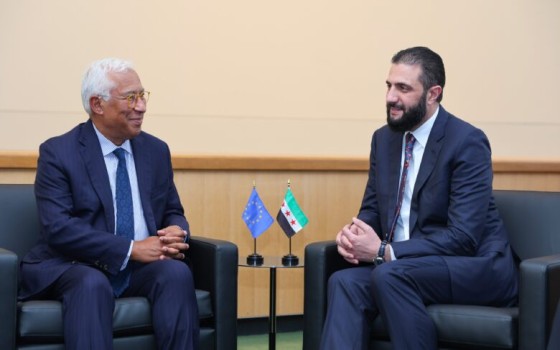
The first high-level political dialogue between the European Union and Syria will take place in Brussels tomorrow, Monday, on the sidelines of a meeting of EU foreign ministers. This dialogue will represent an opportunity to make progress towards normalizing relations between the EU and Syria, and to assess the various avenues of action related to EU support for the efforts of the Syrian transitional authorities aimed at achieving stability in Syria, socio-economic recovery, and a comprehensive political transition. According to a statement issued by the European Union institutions in Brussels, the meeting will be co-chaired by the High Representative of the European Union for Foreign Affairs and Security Policy, Kaja Kallas, and the Minister of Foreign Affairs and Expatriates in the Syrian Interim Government, Asaad Hassan al-Shaibani. The European Commission will be represented by the Commissioner for the Mediterranean, Dubravka Šuić, and the Commissioner for Equality, Preparedness and Crisis Management, Hadja Lahbib. Last December, a year after the fall of the Assad regime, the European Council reiterated its support for a peaceful and inclusive transition in Syria and stressed the importance of protecting the rights of all Syrians, regardless of ethnic or religious background, without discrimination. It expressed concern about foreign interference in the Syrian transition and urged all actors, both domestic and foreign, to fully respect Syria's unity, independence, sovereignty, and territorial integrity, in accordance with international law. The statement, issued by the European Union in Brussels, added that the EU and its member states are among the leading donors of international aid to those affected by the conflict in Syria. Since the beginning of the crisis in 2011, the EU and its member states have mobilized more than €37 billion to support Syrians inside Syria. The country and the region.
Brussels Conferences on Syria
Since 2017, the European Union has convened annual conferences on Syria and the surrounding region, with the aim of supporting the Syrian people and neighboring countries hosting Syrian refugees, and mobilizing the international community to support a peaceful and inclusive political solution to the Syrian crisis.
These conferences have provided opportunities for in-depth dialogue with Syrian civil society (including representatives from Syria, neighboring countries, and the diaspora), key UN actors and agencies, EU Member States, representatives of other countries, and international NGOs.
At the 2025 conference, entitled “Standing with Syria: Meeting the Needs for a Successful Transition,” the EU and its partners committed a total of €5.8 billion (of which approximately €2.5 billion is from the EU) for 2025 and 2026. These funds will be used to support the transition process in Syria, the country’s socio-economic recovery and reconstruction, as well as to address urgent humanitarian needs within Syria and in host communities in Jordan, Lebanon, Iraq, and Turkey. The European Union in Brussels announced contributions of €37 billion in humanitarian, development, economic, and stabilization aid.
EU humanitarian aid focuses primarily on basic needs and promotes the delivery of life-saving assistance.
This aid is channeled through humanitarian partners – NGOs, UN agencies, and the International Red Cross and Red Crescent Movement – who provide the most vulnerable with healthcare, food assistance, water, sanitation and hygiene services, protection, shelter, and education. The EU suspended all forms of bilateral cooperation with the Syrian government and its allies in May 2011, following an escalation of violence and a deterioration of the human rights situation.
EU Sanctions Against Syria
Between 2011 and 2024, the EU imposed sanctions on the Assad regime. However, after the regime's fall, on February 24, 2025, the EU suspended a number of sanctions, including those targeting the energy, transport, and financial sectors, to facilitate engagement with Syria. And its people and companies.
On May 28, 2025, the European Union lifted all economic sanctions on Syria, except those imposed for security reasons.
The remaining economic sanctions include:
An arms embargo
Restrictions on the export of dual-use goods, equipment, and technologies used for internal repression, and surveillance and monitoring software
A ban on trade in goods that are part of Syria’s cultural heritage
At the same time, the EU decided to maintain sanctions on individuals and entities associated with the Assad regime and responsible for the violent repression of the Syrian people and human rights violations. The EU stated that 318 individuals and 58 entities are subject to sanctions.
The listed individuals and entities are subject to asset freezes, and no funds or economic resources are made available to them. Individuals are also subject to travel bans.
These sanctions were last extended until June 1, 2026.
In addition, between 2023 and 2025, the EU imposed sanctions on individuals and entities responsible for human rights violations under the global human rights sanctions regime.




No Comments Found