
The Beginning of a European Shift Against America and Israel: Spain Calls for a Unified Army and an End to Dependence... and a Green Light for New Sanctions Against Settlers

- Europe and Arabs
- Monday , 11 May 2026 8:12 AM GMT
Brussels: Europe and the Arabs
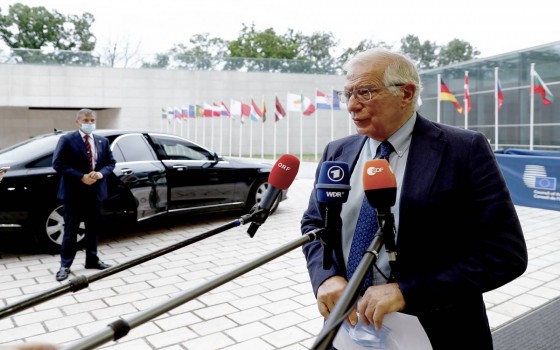
Under the headline "Spain Says Europe Needs Its Own Deterrent Force," the European website Playbook reported from Brussels: Spanish Foreign Minister José Manuel Álvarez told Playbook that the European Union must build its own army so that adversaries like Russia are not tempted to exploit doubts about whether the United States will intervene to save it.
In an exclusive interview in Madrid, ahead of today's Foreign Affairs Council meeting in Brussels, Álvarez said: "We cannot wake up every morning wondering what the United States will do next. Our citizens deserve better."
So what? Álvarez described the Iranian crisis as a crucial moment for Europe's strategic independence. He said: “This is a moment for European sovereignty and independence. The Americans are calling us to it. We must free ourselves from dependency. Freeness from dependency means freedom from coercion, whether it be tariffs or the threat of military force. And freedom from the consequences of others’ decisions.” Madrid barred US military aircraft from its air bases because of the war, and the US responded by threatening Spain with a trade embargo, troop withdrawals, and even suspension from NATO.
“We need a common army, a common defense capability,” Álvarez said, adding that this should not be seen as an attempt to undermine NATO. “The US has been strengthening its military, and nobody thinks that weakens NATO. If NATO no longer provides the security it once did… we Europeans have to do more.”
“Don’t mess with me,” Álvarez said, referring to NATO’s collective defense clause. “The magic of NATO is that you’re a member and nothing happens because nobody dares to test the effectiveness of Article 5.” “This is what we need to rebuild—deterrence. If you want to mess with me, go somewhere else. Because we will stand together.”
The Trump reality: “We firmly believe in transatlantic relations,” Albares said. “For me, the United States is the natural, historical ally of Europeans.” But he added: “We need cooperation from both Europeans and Americans. And we have to accept that the Trump administration has a new vision and new ideas about transatlantic relations.”
Albares’s remarks reflect a broader shift in the EU’s tone, as even the most ardent pro-transatlantic states are forced to confront the reality that Washington is not a predictable ally, a realization exacerbated by the Iran war.
The next round of discussions in the European Parliament and the European Council to finalize the EU-US trade agreement is likely to take place on May 19, with MEP Bernd Lange stating that negotiators “will stick to our timetable.”
Sanctions to Move Forward
Sanctions on Settlers: The European Union is set to move forward with a political agreement to impose sanctions on so-called violent settlers in the West Bank, provided the new Hungarian government approves the deal at today's meeting of foreign ministers, according to four diplomats and EU officials who spoke to Playbook.
Breaking the Stalemate: This would mark the first time in months that the EU has secured unanimous support for sanctions against Israel, after member states blocked previous efforts at the height of hostilities in Gaza.
What to Expect: The political agreement expected today would pave the way for sanctions against a number of individuals involved in settler violence in the West Bank, a move that has drawn criticism from EU leaders, including German Chancellor Friedrich Merz. Israel's ambassador to the EU stated that his country is in "constant and direct" contact with the European Commission on all aspects of the relationship, and that diplomacy should be conducted "directly, not publicly."
Background information: While the original proposal included the names of Israeli ministers Itamar Ben-Gvir and Bezalel Smotrich, their names were later removed from the list, allowing the sanctions to garner support from 26 of the 27 EU member states, according to a senior EU official. The only country to refuse to join was Hungary. An agreement now appears more likely after Péter Magyar was sworn in as Hungary's prime minister.




No Comments Found