

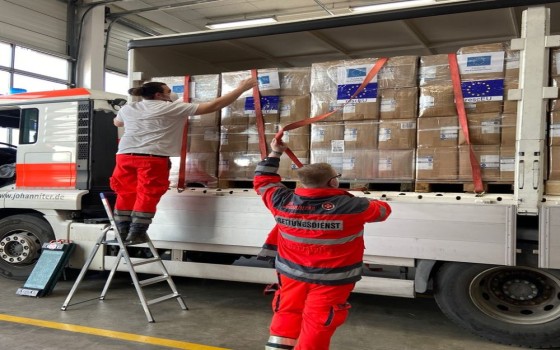

Following the US commitment to humanitarian funding, the European Union says: We will continue working with partners to uphold international humanitarian law, protect civilians, and ensure aid access in crisis situations around the world.

- Europe and Arabs
- Saturday , 16 May 2026 6:51 AM GMT
Brussels – New York: Europe and the Arabs
The European Commission in Brussels, through a statement issued by Commissioner for Humanitarian Aid Hajia Habib, welcomed the US commitment to humanitarian funding, adding: “This step sends an important message of solidarity to the most vulnerable populations around the world.”
The European Union affirms its readiness to work closely with the United States to provide an effective response to humanitarian crises worldwide.
Support for life-saving aid has become more vital than ever for humanitarian organizations to enable them to deliver urgent assistance to those affected by conflict, displacement, food insecurity, and natural disasters.
The best way forward is clear: to ensure the continued sharing of international responsibility and to uphold the importance of humanitarian action based on humanitarian principles, neutrality, impartiality, and independence.
Strong coordination between donors and humanitarian actors remains crucial to maximizing impact and ensuring that aid reaches those most in need, regardless of their identity, location, or beliefs. In an increasingly fragile global environment, sustained humanitarian funding from donors and multilateral cooperation remain essential.
The European Union will continue to work with its partners to uphold international humanitarian law, protect civilians, and support humanitarian access in crisis situations around the world.
UN Secretary-General António Guterres welcomed the United States’ announcement of an additional $1.8 billion in funding for humanitarian operations. He said this commitment will enable humanitarian workers to reach millions of people in the midst of the most urgent crises and provide life-saving support.
Tom Fletcher, UN Under-Secretary-General for Humanitarian Affairs and Emergency Relief Coordinator, also welcomed the US announcement of this additional support.
He further noted that the US announcement of $2 billion in funding in December came at a critical time, when humanitarian operations in many crises were at risk of shutting down.
He added that this funding helped stabilize a system that was under severe strain and allowed the Humanitarian Reset Initiative to focus more precisely on prioritizing, improving efficiency, empowering humanitarian coordinators, and strengthening accountability. According to the UN Daily News
At a joint press conference at UN Headquarters with the US Ambassador to the UN and a US State Department official, Fletcher said: “We moved quickly. $1.68 billion has been allocated for principled, neutral, and needs-based humanitarian action in 18 crises, with the goal of reaching more than 22 million people with life-saving support. We halved the usual allocation time to ensure the funds reach those in need more quickly.”
He explained that more than 90% of this support is directed to those facing the most dire circumstances, in line with the UN’s plan to save 87 million lives this year.
Fletcher said, “This is an extremely challenging time for humanitarian workers. We are under immense pressure, facing resource shortages, and experiencing an increase in attacks.”
Despite this, he emphasized that they have proven their ability to achieve results, even under the most difficult conditions.
He added, “This second disbursement reinforces the urgent actions taken this year and will enable us to accelerate and scale up this progress, protecting millions of lives in times of greatest need.” At the press conference announcing the additional funding, he stated, "There are over 300 million people who need our support, while we face a decline in global funding. As a result, we are stretched to our limits, resource-poor, and literally under attack." The United States Permanent Representative to the United Nations, Ambassador Mike Waltz, said at the same press conference that the benefit of this funding would not only be saving more lives around the world, "but it will also advance the reforms we have undertaken to ensure efficiency, accountability, and lasting impact."
Walt spoke about what he described as the next step in the UN reform process, noting that his country remains among the most generous donors in the world, not only through this official development assistance, but also through hundreds of billions of dollars in private sector contributions.
He added, "We are working to address the bureaucratic bloat that often undermines the effectiveness of the UN mission. In this regard, we have already achieved a historic milestone this year by implementing the first-ever reduction in the UN's regular budget." He denied that the United States had abandoned its responsibilities, emphasizing that they would ensure a larger share of every dollar actually reached those in need. He added, "This is a shared goal that we should all strive to achieve."
He recalled his country's announcement last December of $2 billion in funding to "advance reforms in the field of relief through the Humanitarian Reset Initiative," led by the Under-Secretary-General for Humanitarian Affairs.
Jeremy Lowen, Acting Under Secretary of State for Foreign Assistance, Humanitarian Affairs, and Religious Freedom, spoke about the criteria his country had established since announcing that funding in December and about the regions that would receive it, saying, "We selected those countries very carefully and deliberately to ensure alignment of interests."
He reiterated that "when we act generously as a humanitarian donor, every taxpayer dollar spent must be directed in the best interests of the United States." He said that when they reviewed Fletcher's plan, which prioritized countries and the nature of the crisis, "we pointed out that there are many areas where our interests intersect. Conversely, there are other areas where this intersection may not occur, and therefore we are not obligated to fund them...and other donors can fund them."






No Comments Found