


Resignation of the Belgian Government: Opposition Calls for New Elections Following the Prime Minister’s Political and Personal Failure; Promised "Historic Reform Government" Collapses Amidst Disputes Over Taxes and the Budget

- Europe and Arabs
- Tuesday , 3 November 2026 7:11 AM GMT
Brussels – Europe and the Arabs
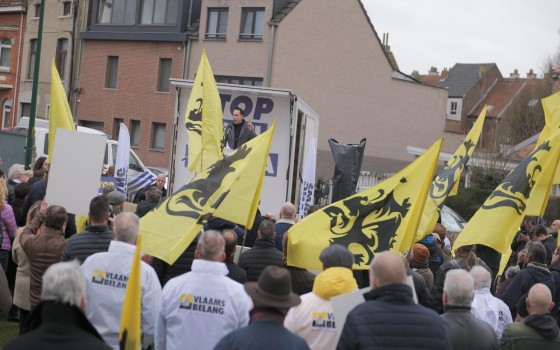
The far-right opposition party in Belgium, Vlaams Belang, has issued a statement regarding recent political developments in the country. It notes that after Prime Minister Bart De Wever (of the New Flemish Alliance, N-VA) failed once again to reach a budget agreement within his government, he turned to King Philippe—who subsequently decided to put the resignation on hold. For Vlaams Belang, this represents a catastrophic political and personal failure for De Wever. Barbara Pas, the party’s parliamentary group leader, stated: "This is a transparent political ploy by a Prime Minister who refuses to take responsibility. De Wever was given every means to prove his ability to govern Belgium. Now that he has failed, this so-called Flemish nationalist turns to the Belgian King, seeking a way out. The political decline of the New Flemish Alliance could hardly be worse." Tom Van Grieken, leader of Vlaams Belang, views this as yet another low point for a government that began with grand promises. He added: "The 'historic reform government' promised by De Wever has gradually devolved into a series of historic failures." Furthermore, De Wever’s appeal to the Palace is not without precedent; during a previous budget crisis, he also turned to the King and was granted additional time to persuade his government to reach an agreement. While the government did eventually reach a budget deal, it has found itself facing a fundamental crisis once again just one year later. "This seems to have become a recurring pattern," says Bas. "When things go wrong, De Wever does not take responsibility; instead, he looks for an institutional way out. The man who spent years claiming that Belgium 'doesn't work' is now demonstrating, in his role as Prime Minister, that he himself is incapable of making it function. From missed deadlines and internal discord to yet another visit to the King—De Wever simply isn't up to the task of being Prime Minister."
"Ultimately, this entire crisis boils down, once again, to the question of how much additional taxation can be imposed." According to the Vlaams Belang party, the King’s decision to put the resignation on hold underscores the depth of De Wever’s political predicament. After months of stalling, missed deadlines, and failed negotiations, the crisis has reached the desk of the head of state—all while Belgium faces the prospect of relying on an emergency budget with temporary monthly installments for the second year in a row. "This is an absolute disgrace for a government with full executive powers," Bas remarks. "De Wever tried to offload his problem onto the Palace, but that does not absolve him of responsibility. He is the Prime Minister who has failed to unite his own majority." Van Grieken points out that the stakes are extremely high: "At its core, this crisis is once again about how much more tax can be levied. Despite all the promises of reform and getting things back on track, this government is on the verge of failing to pass a full budget on time for the second consecutive year. That says everything one needs to know about De Wever’s so-called reform agenda." According to Vlaams Belang, a visit to the Royal Palace serves only to buy more time for a government mired in a political stalemate. Van Grieken concludes: "This solves nothing. The same majority, the same divisions, and the same budget deficit remain. Anyone who, after all these failures, is still unable to reach an agreement on the government's most important task, should stop stalling for time." Bass adds: "Enough is enough. If this government can no longer find a way forward, it is only fair to give the voters another chance to express their views."
According to Belgian media reports circulating on social media, the Royal Palace announced its decision following a meeting between the King and Bart De Wever on Monday morning. Bart De Wever submitted his resignation to King Philippe, following the "collapse of budget negotiations" overnight from Sunday to Monday. However, the King has "deferred a decision on this resignation and will begin consultations today with the leaders of the parties that make up the ruling coalition." Consequently, the coming hours and days will see a round of consultations—a move also aimed at buying time.
For his part, the King expressed his "regret over the failure to reach an agreement that would provide the country with a credible budget, one capable of meeting current challenges." King Philippe added: "Given the context of significant geopolitical uncertainty and grave economic challenges, the country cannot afford a prolonged political crisis." He continued: "Therefore, the King calls upon everyone to act with a sense of responsibility, and urges all concerned parties to prioritize the public interest and adopt a spirit of compromise." As is customary, this statement was issued in coordination with the Prime Minister himself, whom the King "will receive again on Friday, November 6, 2026." This leaves a four-day window to attempt to overcome the deadlock within the "Arizona" coalition—noting that previous deadlines set by the government and the Prime Minister have already passed without any resolution.
A Power Struggle: The Left and Center versus the Right
Overnight from Sunday to Monday, negotiators within the "Arizona" coalition concluded their meetings without reaching an agreement on the budget—specifically, failing to find a compromise on how to secure the ten billion euros required to reduce the fiscal deficit by 2029. Consequently, the Prime Minister informed his partners of his intention to meet with the King, even though none of the Deputy Prime Ministers wished for the negotiations to end or for the government to collapse. One participant summarized the situation, stating: "Bart is heading to meet the King; I hope this serves as a positive shock to the partners, shifts the prevailing mindset, and facilitates a final attempt to reach an agreement between Monday and Tuesday. Otherwise, we will face a profound crisis." In any event, reaching an agreement proved impossible on Sunday evening. The Prime Minister warned of the risk of a credit rating downgrade for Belgium should no deal be reached, highlighting the potential financial repercussions for the country. He also firmly rejected the use of the "provisional twelfths" (*douzièmes provisoires*) system—a mechanism that would freeze budget allocations and allow the year 2027 to begin without a new budget in place. Furthermore, he proposed a gradual reduction in the salaries of federal ministers for the duration of the budget negotiations, a suggestion that was also rebuffed. The same fate met his "stability act," which included urgent measures to curb national debt—centered primarily on a "temporary freeze of the wage index" (*saut d’index*).
Consequently, the internal government conflict between the left-center bloc and the right-wing faction has reignited. Ever since the Reformist Movement (MR) rejected a one-percentage-point increase in the value-added tax (VAT), the *Vooruit* party has opposed any compensatory measures that might affect the healthcare sector or the mechanism that links social benefits to the price index. On Sunday, the *Les Engagés* party aligned itself with this position, proposing an increase in the capital gains tax from 10% to 15%, alongside higher taxes on stock market transactions, the inclusion of registered shares under the scope of the securities tax, and the imposition of stricter taxation on management companies (*sociétés de management*). Read also: The Federal Budget: With only hours left before the deadline, the crisis within the "governing coalition" (known as the "Arizona" coalition) has resurfaced, embodying the classic conflict between the left (or center) and the right.
From the perspective of the liberals, there has been a persistent belief that the proposals on the table include an excessive tax burden, coupled with insufficient cost-cutting measures. On Monday morning, Deputy Prime Minister David Clarinval wrote on social media: "The level of taxation being proposed remains far too high—well beyond what was stipulated in the coalition agreement. Refusing to implement genuine reforms to reduce public spending will only exacerbate the country’s deficit—a deficit that tax revenues can no longer cover, as international organizations have confirmed. The only way to ensure sound public finances and secure the country’s future is by stimulating economic growth."
Meanwhile, the Christian Democratic and Flemish party (CD&V)—which on Sunday held both the "Vooruit" and "Reformist Movement" (MR) parties responsible for the dispute over taxes, describing the situation as "seemingly intractable"—called on Monday morning for an urgent resumption of negotiations, asserting: "We have no time to waste; all partners must recognize the gravity of the situation and return to the negotiating table as soon as possible."






No Comments Found