

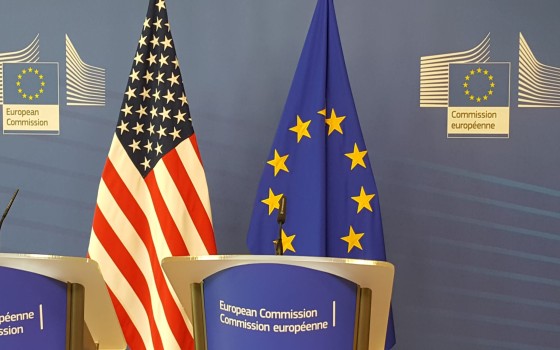
Phone Talks Between European Commission President and US President: Discussions Covered the Situation in the Middle East and Coordination with Regional Partners... The Main Topic Was Contentious Trade Issues

- Europe and Arabs
- Friday , 8 May 2026 6:14 AM GMT
Brussels: Europe and the Arabs
Following a telephone conversation between European Commission President Ursula von der Leyen and US President Donald Trump, a European statement issued in Brussels quoted von der Leyen as saying, "I had a very productive call with President Trump. We discussed the situation in the Middle East and our close coordination with our regional partners. We all agree on the need to prevent Iran from acquiring a nuclear weapon. Recent events have clearly demonstrated that the risks to regional stability and global security are very serious. We also discussed the EU-US trade agreement. We are fully committed, on both sides, to its implementation. Significant progress is being made towards reducing tariffs by early July."
The call came after a US federal court ruled that President Donald Trump's 10% tariffs on global trade were illegal, representing another legal setback after the Supreme Court struck down his more sweeping global tariffs earlier this year, according to Playbook magazine in Brussels, the European edition of Politico. Playbook explained, "According to our colleagues in Washington.” Adding, just before that: Trump gave the EU a two-month deadline to implement a trade agreement with the US before he would raise tariffs to “much higher levels.” Trump informed Ursula von der Leyen of the July 4 deadline during a “productive” phone call with the European Commission president. The European magazine asked whether the EU should award contracts to American companies. Under the headline “Putting the EU First,” it stated: The EU is gradually moving towards a major shift in how it spends public money, a shift that could deprive American companies of billions of euros in taxpayer-funded contracts for goods and services. European Industry Commissioner Stefaan Sigurdsson is taking a firm stance in this debate.
A series of EU decisions regarding US participation in public procurement have been deadlocked, with some governments fearing retaliatory measures if America is excluded. But this impasse appears to be nearing its end. What has changed is Washington’s growing unreliability, coupled with China’s show of industrial power and increasing concern about slowing growth in Europe. This has given momentum to what was initially a French effort to halt the directive. EU funds will flow to non-European companies.
In return: “Countries wishing to access European public procurement markets will have to open up their own markets in return,” Sigourney told Playbook. The commissioner is a leading advocate of this policy, and his intervention is seen as a signal to the United States, which has imposed hefty tariffs on EU exports. But it also acknowledges China, which is tightening its grip on access to its industries and resources.
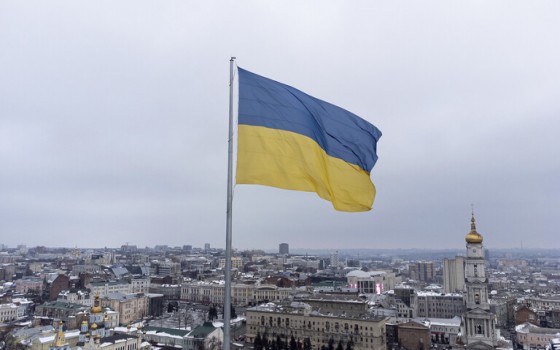
No immediate change: “Any fundamental shift in principles requires time, persuasion, and consensus-building,” Sigourney said. “The more the world changes, and the more we explain it in detail, the more support there will be.” According to Sigourney, enshrining the principle of European priority in procurement rules “changes the balance of power in global trade negotiations.” The battleground: The conflict is already centered on the “Ukraine Facility,” the EU compensation fund that will provide €3 billion to companies supporting the country’s reconstruction next year. The Commission has put forward proposals to allow US companies access to these funds, even as Washington reduces its financial support to Kyiv. This has angered some capitals, with France leading the campaign to exclude US companies. A vote on the issue was postponed on Tuesday after political wrangling among national delegates and is expected to take place later this month, two diplomats from both sides told Playbook. “With tensions rising with the US, it’s becoming increasingly politicized,” a senior European diplomat said. Some fear the move could provoke retaliatory actions. “Are we going to upset Washington knowing its support…” one diplomat asked. Is there any doubt about Ukraine?




No Comments Found