

Plastic Pollution: A Ballooning Bill Threatening the Economy and Environment – Prepared by Dr. Abdel-Moneim Sedky, Professor at the Agricultural Research Center

- Europe and Arabs
- Wednesday , 7 October 2026 6:20 AM GMT
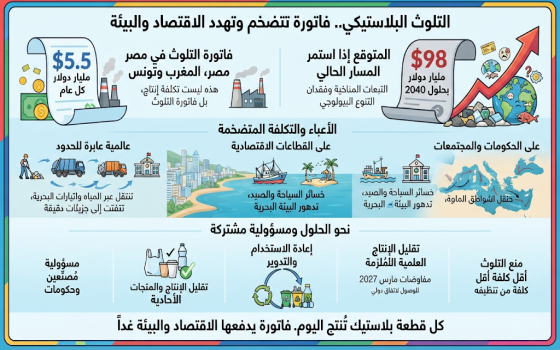
$5.5 billion annually. This is not the cost of producing plastic, but the bill for the pollution it causes in Egypt, Morocco, and Tunisia. Even worse, this figure could surge to approximately $98 billion by 2040 if the world continues to produce, consume, and dispose of plastic in the same way. Behind these figures lies a story far greater than just bags, containers, and bottles piling up on streets and beaches. It is a bill paid by public budgets and borne by coastal communities, manifesting as losses in sectors that rely on the sea and natural resources. Plastic is cheap to buy, but costly once it becomes waste. Governments spend money on waste collection, transport, and disposal; cities pay to clean streets and public areas; and coastal communities face the costs of beach cleanups and dealing with marine environmental degradation. Meanwhile, marine-dependent sectors—from tourism to fisheries—bear further losses as environmental quality declines and waste accumulates.
This is the core message of the report *The Hidden Price of Plastic: Assessing the Economic and Environmental Burdens of Plastic Pollution in Egypt, Morocco, and Tunisia*, published by Greenpeace MENA: the problem does not end when we toss plastic into the trash; rather, a new phase of costs begins. The situation is further aggravated by the fact that many plastic products are used for mere minutes or hours, only to become waste with environmental impacts that can persist for decades. If waste fails to reach collection and processing systems, it may find its way to open dumpsites, rivers, or waterways—and ultimately, the sea.
In the Mediterranean specifically, borders lose their meaning; a piece of plastic beginning its journey on land can travel via water and marine currents to a distant location. Over time, it may fragment into microplastics that are difficult to collect and remove. Thus, what appears to be a local issue transforms into a regional, transboundary crisis. This matter is of particular importance to Egypt, Morocco, and Tunisia—nations economically and environmentally linked to the Mediterranean. Their coastlines are not merely natural landscapes; they are vital sources of income, employment, tourism, and fisheries. Consequently, any degradation of these areas entails economic costs that far exceed the value of the waste itself.
In Egypt, these risks are compounded by the country's extensive coastlines along both the Mediterranean and the Red Sea, as well as the critical importance of tourism, marine resources, and coastal activities. As the volume of plastic leaking into the environment grows, cleanup and remediation become increasingly difficult, and the cost of recovery rises. Yet, the crisis extends well beyond these three nations; the entire world is drowning in plastic. Production is surging and consumption is expanding, while waste collection and recycling systems struggle to keep pace with the mounting influx. As a result, a vast amount of plastic ends up in landfills, the environment, or is incinerated, rather than being reintegrated into a new cycle of use.
This is where the climate dimension of the crisis becomes apparent: plastic is inextricably linked to fossil fuels—from raw materials through manufacturing and transport to final disposal. Consequently, the plastic crisis is no longer merely a waste management issue; it is inextricably linked to climate change, biodiversity loss, and ecosystem degradation. Perhaps the most alarming figure is $98 billion—the potential cost by 2040 if the current trajectory continues. This figure is not just a financial projection; it reflects the cost of inaction. Every year of delay translates into more waste, increased pollution, and greater financial resources required to address the consequences.
The equation is simple: preventing pollution costs less than cleaning it up after the fact. Accordingly, the international discourse is gradually shifting from the question "How do we get rid of plastic?" to a more fundamental one: "How can we produce and use less of it in the first place?" Negotiations for a global treaty on plastic pollution are set to resume in March 2027, aiming to secure a legally binding international agreement to tackle the crisis, including pollution in the marine environment. These negotiations come at a critical juncture for nations bearing the brunt of pollution on land and at sea. The objective goes beyond merely scaling up cleanup operations or improving waste management; it extends to reducing unnecessary plastic production, curbing single-use products, promoting reuse, enhancing collection and recycling systems, and providing the necessary funding and technology to countries requiring support during this transition.
For Egypt, Morocco, and Tunisia, these negotiations offer an opportunity to highlight the costs they already incur and to advocate for solutions that do not simply shift the burden from one stage to another, but rather address the crisis at its source. The problem is no longer just about the bag, the bottle, or the package; it lies in an entire system that generates vast quantities of plastic—amounts that neither the environment nor waste management systems can handle.
Ultimately, the annual $5.5 billion bill across these three countries reveals a hard-to-ignore truth: plastic that appears cheap at the moment of purchase can become incredibly costly once discarded. If that figure climbs to $98 billion by 2040, the question will no longer be about the cost of plastic itself, but rather the cost of delaying action.
Every piece of plastic produced today that lacks a safe disposal route after use could tomorrow become a bill footed collectively by the economy, the environment, and society.






No Comments Found