


Can Artificial Intelligence Save a Planet Burdened by the Digital Revolution? — Prepared by Dr. Abdel-Moneim Sedky, Professor at the Research Center, Egypt.

- Europe and Arabs
- Monday , 21 September 2026 6:4 AM GMT
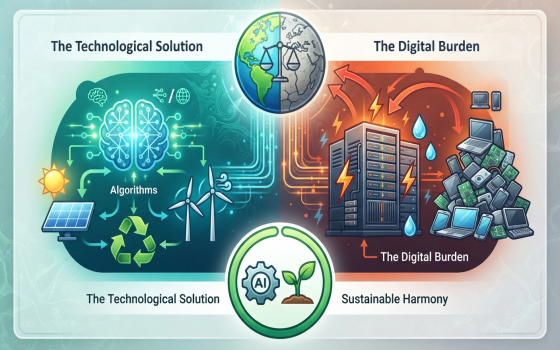
In an era of unprecedented technological innovation, the planet faces complex challenges; massive leaps in cloud computing coincide with rapidly accelerating environmental degradation. United Nations reports indicate a record 42% decline in global water reserves, while resource consumption rates exceed the planet's regenerative capacity by more than 70%. Humanity thus faces a critical balancing act between the demands of technological advancement and the imperative to preserve our natural habitat.
Beneath the glittering façade of the digital revolution lies a sector that silently consumes the Earth's resources. Data shows that information technology accounts for 4% to 10% of global electricity consumption, driven by the energy-intensive nature of artificial intelligence processing centers, which deplete millions of liters of water daily for cooling purposes. Simultaneously, the e-waste crisis is escalating, with annual volumes exceeding 50 million tons—yet actual recycling rates remain at just 17%—threatening an accumulation of toxic pollutants that endanger local ecological balance.
Conversely, technology cannot be reduced merely to a source of environmental strain; it is an indispensable tool for managing climate crises. Modern models leverage machine learning algorithms to predict natural disasters with over 85% accuracy and reduce waste in water and energy networks by up to 30%. Contemporary innovations also contribute to enhancing the efficiency of renewable energy sources and activating circular economy mechanisms to reallocate resources with optimal effectiveness.
From a strategic perspective, the current challenge represents a legislative and ethical crisis requiring a decisive response to avert the dire consequences of escalating digital emissions. There is an urgent need to enforce strict regulatory standards ensuring that major corporations achieve full carbon neutrality, and to direct a pivotal share of applied research toward reducing the digital sector's carbon footprint, alongside fostering a culture of conscious, prudent consumption.
The integration of technological advancement and environmental sustainability is not a luxury; it is the fundamental pillar for ensuring the survival of vital ecosystems. The ultimate goal is to harness artificial intelligence as a genuine driver for a sustainable green transition, without undermining the planet's ecological balance.










No Comments Found